







flow

Where do rivers start? That’s a question that has always fascinated me, basically because I know that the Nile, the Amazon and the Thames – as majestic and life-giving as they and many of the world’s other great rivers become – all begin as mere trickles. Indeed, with the notable exception of rivers that erupt from the ground as powerful streams, most great rivers start out as subtle emanations of water that has migrated, globule by globule, through vast areas of porous rock to emerge as tiny rivulets in zones known as “spring lines.” These spaces typically exist between

As a sculptor, I always seek ways to use my work to create positive (and sometimes intellectually challenging) experiences for those who have the opportunity to see what I've done. In my case, most of the time I'm not trying to make direct, narrative or literal statements. Instead, I seek to conjure feelings of fascination that lead to appreciation and enjoyment: You don't necessarily have to understand the forms I create to walk away from them with good feelings. When I have the opportunity to work in public settings (as was the case in the project featured on these pages), I'm stimulated by the idea that large numbers of people will be exposed to my sculpture and that, in many cases, those people will be exposed to what I've done over and over again because they'll be passing by at least twice each day as they go to and from their jobs in adjacent buildings. In this case, I was working next to an office tower in Century City - a famous business and entertainment district near downtown Los Angeles - which meant that thousands would repeatedly be walking right past my work and would come to accept it as part of their daily lives. In that light, I see art set amid architecture as a permanent commitment, as a cultural reference that has the potential to resound for generations. This recognition fills me with a heightened sense of
As a sculptor, I always seek ways to use my work to create positive (and sometimes intellectually challenging) experiences for those who have the opportunity to see what I've done. In my case, most of the time I'm not trying to make direct, narrative or literal statements. Instead, I seek to conjure feelings of fascination that lead to appreciation and enjoyment: You don't necessarily have to understand the forms I create to walk away from them with good feelings. When I have the opportunity to work in public settings (as was the case in the project featured on these pages), I'm stimulated by the idea that large numbers of people will be exposed to my sculpture and that, in many cases, those people will be exposed to what I've done over and over again because they'll be passing by at least twice each day as they go to and from their jobs in adjacent buildings. In this case, I was working next to an office tower in Century City - a famous business and entertainment district near downtown Los Angeles - which meant that thousands would repeatedly be walking right past my work and would come to accept it as part of their daily lives. In that light, I see art set amid architecture as a permanent commitment, as a cultural reference that has the potential to resound for generations. This recognition fills me with a heightened sense of

Our involvement with Vera Katz Park started with a phone call from Alan Beard of GBD Architects, a firm that has been responsible for designing several signature buildings in Portland, Ore. The project at hand was the complex renovation and transformation of the city's National Guard Armory into a modern theater and the new home of the Portland Center Stage Theater Company. After an energetic interview process, we were selected to design the site's landscape. We were enthusiastic about the project from the start. The sidewalk area we were designing is an integral part of the redevelopment of what's known as the Pearl District, a former industrial area now being revitalized with mixed-use buildings and high-rise developments. At 200 feet long by 20 feet wide, the space presented an interesting design challenge in an area much in need of parks and public places. The city's goal is to establish pedestrian connections throughout the neighborhood while creating a sense of community within the district. For our part, we saw the site, which was to be named in honor of former Portland mayor Vera Katz, a devoted supporter of the arts who had been instrumental in the repurposing of the Armory Building, as an opportunity to create a
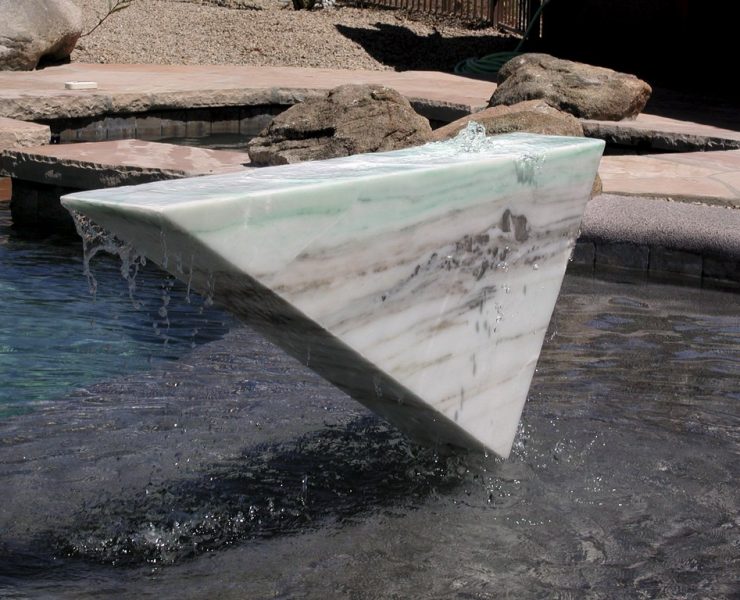
When people ask me how long it takes to create one of my sculptures, I sometimes like to answer, "My whole life." I've always loved art and started collecting it while still in high school, but I never imagined in those formative years that I'd become an artist myself. After all, I have no formal training, and to this day I can't draw - not well, at any rate. My first career was as a computer programmer, my second as a marketing consultant - both distinctly sedentary occupations that led me to seek something physical to do in my spare time. For whatever reason, I decided to try my hand at sculpting stone, crafting a few rough pieces and taking pleasure mostly from the hard work they involved. Right from the start, however, people
When people ask me how long it takes to create one of my sculptures, I sometimes like to answer, "My whole life." I've always loved art and started collecting it while still in high school, but I never imagined in those formative years that I'd become an artist myself. After all, I have no formal training, and to this day I can't draw - not well, at any rate. My first career was as a computer programmer, my second as a marketing consultant - both distinctly sedentary occupations that led me to seek something physical to do in my spare time. For whatever reason, I decided to try my hand at sculpting stone, crafting a few rough pieces and taking pleasure mostly from the hard work they involved. Right from the start, however, people

‘Any time that you can introduce water or the sound of water into an environment, the space is instantly transformed.’ – Geoffrey Lew Rausch, FASLA, 2006 recipient of the Henry Shaw Medal for his work at the Missouri Botanical Garden During the past three decades, the Missouri Botanical Garden has undergone a wonderful transformation, and much of it has been about water. In that span, more than a dozen fountains and waterfeatures have been added to the 79-acre grounds of what many have long been considered to be one of the top three public gardens in the world – and happily, our firm, Hydro Dramatics of St. Louis, has had the privilege of working on all of them as project leaders. These installations have ranged from the simple to the complex. Whether serene or splashing, barely bubbling or shooting skyward, our work has added a unique spirit and drama to many already-beautiful sites. In addition, they’ve involved us in memorable collaborations with the garden’s creative staff, generous sponsors and the more than 850,000 people who come to the garden annually. For our part, the diversity of the watershapes

From the grandest waterfall to the smallest courtyard fountain, water flowing over an edge is one of the most compelling of all watershaping “looks.” Whether it’s a vanishing edge or a slot overflow or a trough, runnel or waterfall, these effects all use one common concept – that is, the weir. Simply defined, a weir is a barrier or dam placed in a channel behind which fluid backs up and then falls through a notch and down the face of the weir. In most watershaping applications, water travels over the weir’s edge or brink and into some kind of lower basin, trough or pool. Physically and visually, these systems are driven by

It certainly doesn't happen very often, but sometimes the addition of a watershape can completely redefine the way a property is perceived. In the case seen here, a nine-acre estate in the mountains above of Malibu, Calif., was zoned for agriculture. The owner's intention in buying it was quite appropriate: He wanted to turn it into a working vineyard brought to life visually by a big stream, pond and waterfall system. Once the watershape took form, however, the owner was so inspired by what he saw that his vision for the property changed and he recast the place as a venue for weddings and other events that would be enhanced by the bucolic, utterly romantic surroundings. In a very direct way, in other words, the watershapes served to increase both the aesthetic and financial value of the property. I'm a romantic at heart, so the notion that the work on display here will be a backdrop for special, memorable occasions has made the big, complicated project even more

I've always been conservative when it comes to guaranteeing my work, which is why I only offer a 300-year warranty on my sculptures. I'm fairly certain that the vast majority of my pieces will last well beyond that span, but there's always the possibility one might be consumed by a volcanic eruption, blown up in disaster of some sort or drowned when the ice caps melt and cover the land with water. Those sorts of cataclysms aside, it's hard to imagine that the massive pieces of stone I use to create what I call "primitive modern" art will be compromised by much of anything the environment or human beings can throw at them. Ultimately, that's one of the beauties of working in stone: It possesses a profound form of permanence - and there's a certain comfort that comes with knowing my work won't be blown away by wind, eroded by rain or damaged by extremes of heat or cold. And given the fact that these pieces are so darn heavy, it's safe to say that most people are going to think at least twice before trying to move or abscond with them. Beyond the personal guarantees and despite the fact I don't dwell on too much, working with stone also has a unique ability to connect me and my clients with both the very distant past and the far distant future. Human beings have been carving stone for thousands of years, and many of those works are still with us in extraordinarily representative shape. There's little doubt that those pieces