







fire features
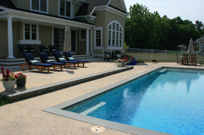
Even these days, when new houses tend to be overly large and their lots tend to be quite small, it’s rare to encounter a situation in which there’s nothing in a backyard other than a basic patio. Indeed, there’s almost always something more to do in designing a backyard — and on many happy occasions, there’s actually a good deal to be done in integrating spaces beyond the patio into
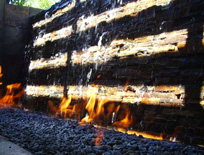
In selecting materials, most of us know enough to think about how our choices will work when exposed to water. Only rarely, however, do we think about how those materials will perform when exposed to fire — which is being featured in more and more projects these days — and how they
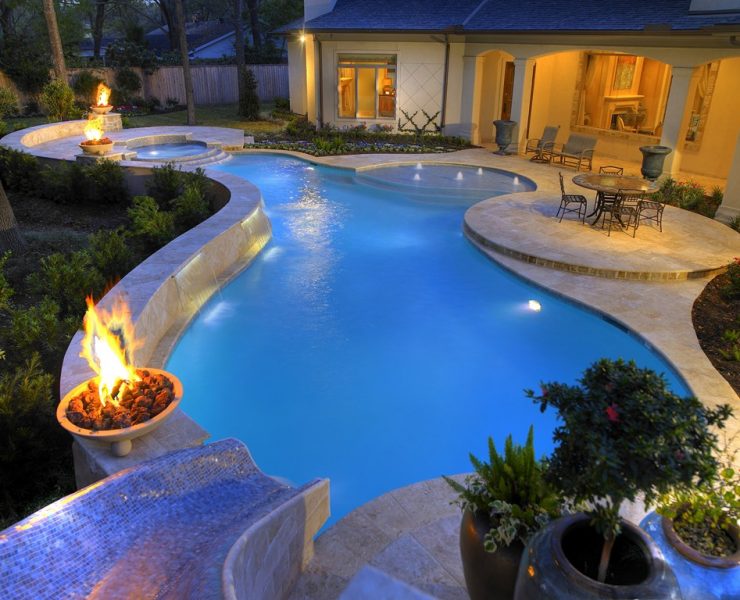
Fire effects have grown tremendously in popularity in recent years, especially among swimming pool designers and builders who use them in developing various fire-on-water features. On one level, it seems that these professionals (and their clients) have noticed that systems that contain and control fire serve as wonderful complements to systems that contain and control water. On a grander scale, however, it’s apparent that, as watershape designers and builders have become more and more creative, fire features have risen in the estimation of those who want to give their clients something special – something few others have. At my company, Grand Effects of Irvine, Calif., we’ve focused on making it easy for watershapers, general contractors and landscape designers and architects to bring fire into the picture across a range of applications. To that end, we’ve developed an array of completely off-the-shelf systems, ready to install, and have done all of the engineering and testing required to build confidence into every product. In doing so, we’ve studied possible effects and developed

{Multithumb} When second-generation metalworker and sculptor Kris Kesler wanted to take his custom waterfeatures to a higher, more artistic level, he took off his welding mask and picked up a computer mouse. It’s been liberating, he says, enabling him to design everything from simple scuppers to hurricane-proof fountains and take care of the details that make them work on screen before he puts his hands in gloves and goes at it with hammer and tongs. Growing up in a family of industrial and commercial fabricators, I was steeped from an early age in traditional metalworking techniques – hammering, planishing, leather-sandbag shaping and my favorite, torch welding. Learning at my father’s knee in his commercial steelwork factory led me to admire the artistry of craftspeople as they transformed raw hunks of metal into functional and often beautiful works of art. The power of that experience has always stuck with me. Later in life, when I decided to launch my own water- and fire-feature company, I was excited to get back behind the welding mask and

One of the things I love about working in the southwest is the way the openness and rugged, sculptural appearance of the natural landscape opens the door to those who want to make bold architectural statements in concrete, stone, steel and glass. Even the plants here have an overtly sculpted quality. I appreciate this all the more by virtue of having worked in more tradition-bound places: Here in the southwest, I feel free to use a strong, contemporary design vocabulary in forging unique connections between built spaces and their dramatic surroundings. Although I'm perfectly comfortable working in those traditional styles, I'll admit to being heavily influenced by the masters of Modernism - particularly Frank Lloyd Wright and the German-born American architect Ludwig Mies van der Rohe - and love the way those amazing mid-20th-century designers used clear, sculptural geometries to direct the eye and define intricate spatial relationships. The project depicted here is a direct channeling of their influence, aided and abetted by

Most people I know have a favorite vacation spot, a favorite leisure-time activity and a favorite form of self-indulgence. In creating backyard environments for these folks, we as watershapers and landscape designers often find ourselves able to roll elements of one, two or all three of those "favorite things" up in a single package in ways that closely reflect our clients' passions and personalities. At my company, we strive to make a direct connection with those preferences by letting our prospective clients know that we want to enable them to vacation in their own backyards and come home to outdoor environments that epitomize the good life. In some cases, that means

It's often said nowadays that watershaping is the art of fitting our work into the surrounding environment. In many ways, what we do at Star Pools in Houston is a prime application of that powerful yet basic concept in the way we tackle both the opportunities and limitations of the residential settings we encounter. Houston is dotted by affluent neighborhoods teeming with homes in classic Mediterranean and Tuscan styles. Stately is a word often used to describe these homes, and because we've based our design philosophy firmly on the idea that the swimming pool and garden areas should look as though they were designed as part of the home itself, our work is largely a manifestation of