








environmental design
To see WaterShapes TV, Part 2, click here mySpace

Among the most gratifying of all projects are those in which designers are able to forge links between different areas of a property, creating an unfolding, choreographed experience that generates notes of anticipation along with reassuring sensations of comfort and familiarity. In our work at Root Design Company (Austin, Texas), we’ve found that water is a powerful tool in defining those sorts of connections within a property, whether it is used in bold ways, as with fountains or swimming pools, or as subtler secondary or tertiary elements, including runnels or small waterspouts. In the project depicted here, we used multiple watershapes within architectural spaces that organize those settings and bring motion and continuity to the overall space. It all ties together visually, with each path leading to intriguing destinations that serve as rewarding visual experiences for anyone who visits. As we see it, the key ingredient in this project was our client, who understood

As a rule, those of us who build watershapes meant for purposes other than swimming or hydrotherapy tend to pursue one path or another: Either we make our ponds, streams and waterfalls look as natural as we can manage, or we establish them to reveal the hand of man either partly or completely. In that either/or context, successful design depends at least in part on being perfectly clear with ourselves about what we are trying to achieve. In assessing ponds of these opposing forms, it's my personal practice to look at both natural ponds and formal ponds (or, more accurately, architectural ponds) as being right on par with one another with respect to their potential for beauty. Indeed, architectural ponds can be incredibly appealing when done up in such a way that
As a rule, those of us who build watershapes meant for purposes other than swimming or hydrotherapy tend to pursue one path or another: Either we make our ponds, streams and waterfalls look as natural as we can manage, or we establish them to reveal the hand of man either partly or completely. In that either/or context, successful design depends at least in part on being perfectly clear with ourselves about what we are trying to achieve. In assessing ponds of these opposing forms, it's my personal practice to look at both natural ponds and formal ponds (or, more accurately, architectural ponds) as being right on par with one another with respect to their potential for beauty. Indeed, architectural ponds can be incredibly appealing when done up in such a way that
As a rule, those of us who build watershapes meant for purposes other than swimming or hydrotherapy tend to pursue one path or another: Either we make our ponds, streams and waterfalls look as natural as we can manage, or we establish them to reveal the hand of man either partly or completely. In that either/or context, successful design depends at least in part on being perfectly clear with ourselves about what we are trying to achieve. In assessing ponds of these opposing forms, it's my personal practice to look at both natural ponds and formal ponds (or, more accurately, architectural ponds) as being right on par with one another with respect to their potential for beauty. Indeed, architectural ponds can be incredibly appealing when done up in such a way that

One of the things I love about working in the southwest is the way the openness and rugged, sculptural appearance of the natural landscape opens the door to those who want to make bold architectural statements in concrete, stone, steel and glass. Even the plants here have an overtly sculpted quality. I appreciate this all the more by virtue of having worked in more tradition-bound places: Here in the southwest, I feel free to use a strong, contemporary design vocabulary in forging unique connections between built spaces and their dramatic surroundings. Although I'm perfectly comfortable working in those traditional styles, I'll admit to being heavily influenced by the masters of Modernism - particularly Frank Lloyd Wright and the German-born American architect Ludwig Mies van der Rohe - and love the way those amazing mid-20th-century designers used clear, sculptural geometries to direct the eye and define intricate spatial relationships. The project depicted here is a direct channeling of their influence, aided and abetted by
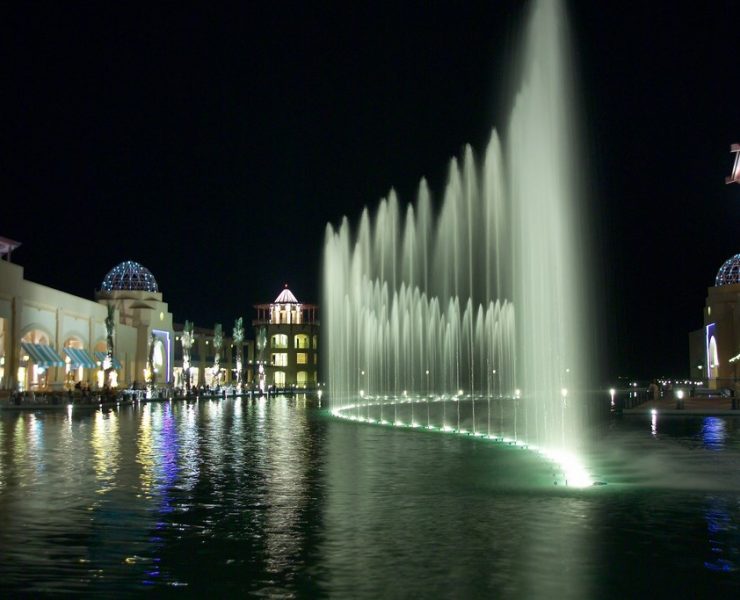
Throughout ancient times, water was central to the thinking of Arab, Persian, Moorish, Moghul and Turkish architects and designers, with largely anonymous representatives of each civilization preparing elaborate spaces with fountains, reflecting pools and other watershapes at their hearts. In the past, these societies' greatest architectural works almost invariably featured elaborate watershapes that bespoke their technical skills as well as a general love affair with the beauty, luxury and necessity of water. With new developments burgeoning across much of the Middle East these days, fountains and watershapes of all varieties are once again playing important roles in design as
Throughout ancient times, water was central to the thinking of Arab, Persian, Moorish, Moghul and Turkish architects and designers, with largely anonymous representatives of each civilization preparing elaborate spaces with fountains, reflecting pools and other watershapes at their hearts. In the past, these societies' greatest architectural works almost invariably featured elaborate watershapes that bespoke their technical skills as well as a general love affair with the beauty, luxury and necessity of water. With new developments burgeoning across much of the Middle East these days, fountains and watershapes of all varieties are once again playing important roles in design as