







engineering

Only three percent of the world’s water exists as fresh water – that is, water with low salinity and total dissolved solids of the sort found in lakes, rivers, reservoirs, ponds, streams and aquifers. It is arguably our most precious resource because, quite simply, we can’t get along without it. As populations grow around the world, the amount of fresh water available for drinking, irrigation, bathing and sanitation annually decreases on a per capita basis. These fresh-water supplies are replenished only by precipitation, so when droughts disrupt historical weather patterns, there’s trouble ahead – especially if the shortages hit highly populated areas. Today, it is estimated that one in six people on our planet lacks access to an adequate water supply. While the vast majority of those who endure this disadvantage live in other parts of the world, we in the United States are becoming more and more subject to supply shortages when localized droughts occur. Recent conditions in the southeastern United States are a prime illustration of what this entails: In Georgia, for example, water supplies recently hit 50-year lows. These conditions resulted in the imposition of all sorts of restrictions on water use, in some areas leading to bans on the installation of new watershapes. At Aquascape (St. Charles, Ill.), we’ve long believed that it’s our responsibility as professional watershapers to act responsibly in such circumstances, meaning in our case that

Sometimes, the main idea that will drive a design jumps to mind as soon as you see the site. That was the case with the project covered here: When I pulled up to the gate of the property - high in the affluent hills of Bel Air, Calif. - what I found wasn't a big, showy home of the sort that have increasingly come to characterize the neighborhood; instead, what I saw was a place defined by subtlety and elegance. It all started with the gate's beautiful brick pilaster, beyond which I could just glimpse a large, lovely home with the distinctive architecture of an English manor house. Even though I hadn't met the clients yet or seen the entire job site, I was already convinced that the project would be
Sometimes, the main idea that will drive a design jumps to mind as soon as you see the site. That was the case with the project covered here: When I pulled up to the gate of the property - high in the affluent hills of Bel Air, Calif. - what I found wasn't a big, showy home of the sort that have increasingly come to characterize the neighborhood; instead, what I saw was a place defined by subtlety and elegance. It all started with the gate's beautiful brick pilaster, beyond which I could just glimpse a large, lovely home with the distinctive architecture of an English manor house. Even though I hadn't met the clients yet or seen the entire job site, I was already convinced that the project would be
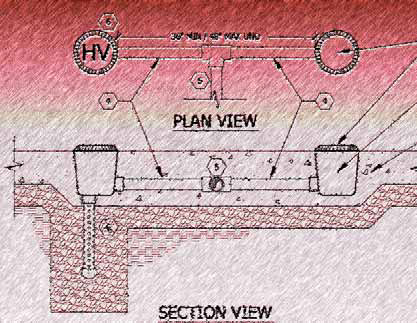
I hadn't planned on breaking away from my coverage of the National CAD Standard anytime soon, but recent events - including the arrest of a pool builder on charges of manslaughter in a suction-entrapment incident - compelled me to do otherwise. As I started composing this column, my plan was to call it "Entrapment Rundown" and make it a straightforward, positive summary of recent changes in codes and systems related to suction entrapment. As I dug more deeply into the topic, however, I found the issues and solutions to be much more confusing than I'd anticipated - so much so that
I hadn't planned on breaking away from my coverage of the National CAD Standard anytime soon, but recent events - including the arrest of a pool builder on charges of manslaughter in a suction-entrapment incident - compelled me to do otherwise. As I started composing this column, my plan was to call it "Entrapment Rundown" and make it a straightforward, positive summary of recent changes in codes and systems related to suction entrapment. As I dug more deeply into the topic, however, I found the issues and solutions to be much more confusing than I'd anticipated - so much so that

As a sculptor, I always seek ways to use my work to create positive (and sometimes intellectually challenging) experiences for those who have the opportunity to see what I've done. In my case, most of the time I'm not trying to make direct, narrative or literal statements. Instead, I seek to conjure feelings of fascination that lead to appreciation and enjoyment: You don't necessarily have to understand the forms I create to walk away from them with good feelings. When I have the opportunity to work in public settings (as was the case in the project featured on these pages), I'm stimulated by the idea that large numbers of people will be exposed to my sculpture and that, in many cases, those people will be exposed to what I've done over and over again because they'll be passing by at least twice each day as they go to and from their jobs in adjacent buildings. In this case, I was working next to an office tower in Century City - a famous business and entertainment district near downtown Los Angeles - which meant that thousands would repeatedly be walking right past my work and would come to accept it as part of their daily lives. In that light, I see art set amid architecture as a permanent commitment, as a cultural reference that has the potential to resound for generations. This recognition fills me with a heightened sense of
As a sculptor, I always seek ways to use my work to create positive (and sometimes intellectually challenging) experiences for those who have the opportunity to see what I've done. In my case, most of the time I'm not trying to make direct, narrative or literal statements. Instead, I seek to conjure feelings of fascination that lead to appreciation and enjoyment: You don't necessarily have to understand the forms I create to walk away from them with good feelings. When I have the opportunity to work in public settings (as was the case in the project featured on these pages), I'm stimulated by the idea that large numbers of people will be exposed to my sculpture and that, in many cases, those people will be exposed to what I've done over and over again because they'll be passing by at least twice each day as they go to and from their jobs in adjacent buildings. In this case, I was working next to an office tower in Century City - a famous business and entertainment district near downtown Los Angeles - which meant that thousands would repeatedly be walking right past my work and would come to accept it as part of their daily lives. In that light, I see art set amid architecture as a permanent commitment, as a cultural reference that has the potential to resound for generations. This recognition fills me with a heightened sense of

Echo Park is one of those places that has come to be defined by an all-too-familiar litany of urban woes: gangs, crime, violence, graffiti and drugs set amid aging buildings and a crumbling infrastructure. Fortunately, the community also has leadership that's working hard to change things for the better. One of the recent and most significant efforts to improve the lives of its citizenry involved renovating Echo Park Deep Pool, the area's only public swimming facility. The $6-million program involved enclosing the big pool with a new
Echo Park is one of those places that has come to be defined by an all-too-familiar litany of urban woes: gangs, crime, violence, graffiti and drugs set amid aging buildings and a crumbling infrastructure. Fortunately, the community also has leadership that's working hard to change things for the better. One of the recent and most significant efforts to improve the lives of its citizenry involved renovating Echo Park Deep Pool, the area's only public swimming facility. The $6-million program involved enclosing the big pool with a new

Given the fact that swimming pools and most other watershapes are placed in the ground, I've long been of the opinion that it's incumbent upon all of us who design and build them to have a basic understanding of soils science and geology. As has been stated in this magazine and elsewhere more times than I can count, the nature of the ground we build in (or on) has everything to do with the structures we design. Indeed, the composition and structure of the soils we encounter may well be the most fundamental of all the technical issue we ever face. Simply put, a watershape that's properly engineered in light of prevailing soil conditions will endure, while one that isn't runs a significant and often inevitable risk of structural failure. Relatively few of us who read WaterShapes are civil engineers, soils scientists or geologists, but all of us