








courtyard

Haddonstone (Pueblo, CO) manufactures self-circulating fountains and waterfeatures in a range of contemporary styles and…

I live on the eastern-most fringe of the west side of Los Angeles, a neighborhood with an eclectic urban concoction of mixed nationalities and wide-ranging aesthetics - including a lack thereof. This hilly East Hollywood region has views of the downtown skyline and cars lined up regularly at four-way stop signs deployed in an effort to minimize the number of streetlights we must navigate to get from our homes to nearby Hollywood and Sunset Boulevards. In short, we are bursting at the seams with

It's a rare project in which a watershaper has the opportunity to execute a complete design without compromise. In our Scottsdale, Ariz.-based business, we often work with upscale clients on custom pool and spa installations, and it seems that there's always some element or other in the design that ends up being altered or left out. It sometimes reaches the point where we start to feel as though the result, although it may be satisfying to the client, is not fully reflective of our talent, our vision or our best effort. The project pictured in these pages, however, is a dramatic exception to that rule. Although the clients were involved with general suggestions during the design process and construction project, when it came down to details of the plan, they let us go ahead and create an environment that fully reflected our creative vision. They'd seen one of our projects in a local "Street of Dreams" program in which area contractors were selected to build spec homes on the same street in a town just north of Scottdale called Troon. Once the row of home was completed, there were tours, awards and lots of media coverage - quite the high-profile affair. The clients had been in contact with four or five different pool builders in the area, but they'd
Most of us are in business to earn a living, which is probably why so many of us think of the high-end market as the place to be. In general, of course, the bigger the job, the larger the paycheck will be. But when I look more closely at the work I've done through my career, I believe we might be overlooking valuable opportunities for personal and professional growth by being so single-minded in pursuing grand, big-ticket jobs. When I started my business 15 years ago, I was happy to find work on small borders in small spaces. Since then, I'm proud of the fact that I have worked my way up to designing for multiple-acre estates. To be sure, I much prefer having a few large jobs to a bunch of smaller ones, but

I've always been fascinated by the concept of urbanism as defined by Thomas Jefferson: He boiled it down to the notion that everyone should have his or her own private space as well as a buffer against the outside world. In a sense, the physical concept of the front yard fits perfectly within Jefferson's utopian ideal. At root, it's an ingenious setup that has probably endured for so many centuries because, on some level, it addresses our primal need to have land all around us. By the very configuration of our residential spaces, we each have a small, open, pastoral area that separates the privacy and sanctity of the home from adjacent public areas, sidewalks and streets. The problem is that in many modern cities and suburbs, the amount of room allocated for front yards in particular has dwindled as property values have soared and lots have become smaller and more tightly packed as a result. And when you combine that spatial shrinkage with the increased desire for safety and privacy on the part of many homeowners, it all works together to place ever-higher premiums on how we choose to make use of our small slices of front-yard land. To my mind, this dynamic set of trends

Looking for inspiration in an urban environment can leave a designer with precious few useful references. Take downtown Chicago, for example, where our indigenous waterfeature is Lake Michigan and our public art is too often plopped in the middle of concrete plazas. Be that as it may, I do my part by trying to introduce both water and art into my projects. So I was thrilled to be retained by Mary O'Shaughnessy, owner of the Wood Street Gallery in Chicago, to design a sculpture garden. I knew it would give me the chance to create a balanced, beautiful space - even though I also knew the job wouldn't be easy. What she wanted was a garden environment in which she could display and sell contemporary American sculpture - a place that would help clients visualize the way the art might look in their own gardens. As we dug deeper, we uncovered additional goals: It needed to be a space that would accommodate a changing variety and number of pieces; it had to be functional for large parties; and it had to incorporate and acknowledge the garden's urban neighborhood while still providing a sense of enclosure for gallery visitors (and, of course,
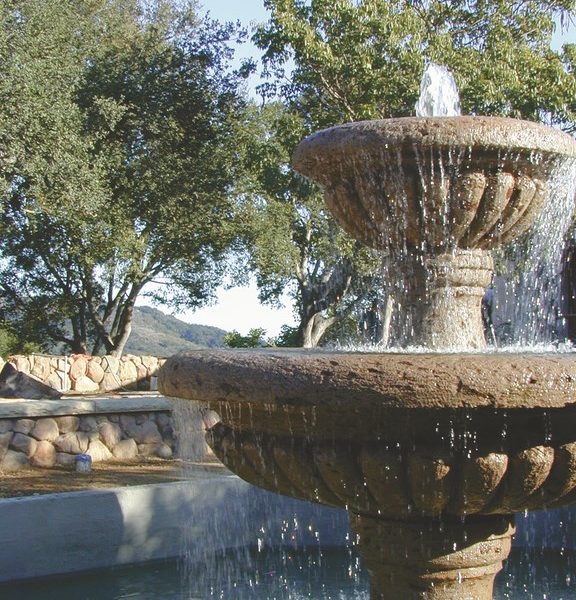
Montecito is home some of the grandest estates on the West Coast, but relatively few people know about it or where it is. A sleepy little town, it lies several miles east of Santa Barbara and some 80 miles or so northwest of Los Angeles. From the beautiful hilltop estates that dot the landscape, you can see Santa Barbara's wharf and downtown in the foreground, with sweeping vistas of the Pacific Ocean dominating the horizon. The big ranches of Montecito are dotted with hundreds of watershapes inspired by the Spanish-Colonial and Moorish architecture that surround them. Most were installed as part of the Spanish Revival movement that took hold among architects and landscape designers all over California through the first half of the 20th Century. The revivalists' octagonal and quatrefoil fountains and courtyards provide a visual link to the state's Spanish heritage. Fueled by the explosion of Hollywood's movie industry during this time, the combination of money, lots of open land and a popular architectural style resulted in creation of some of the most beautiful estates anywhere in the world - none more so than a property named Cima del Mundo, Spanish for