








contrast

'When I paint,' observed Stephanie Rose at the start of her Natural Companions column in October 2006, 'I constantly play with color on canvas and experiment with various combinations to see what works well and discover what, to my eye, clashes or doesn't seem to mix harmoniously.' 'As a landscape designer, I'm aware of working through the same sort of

When used to classify a design style, the term “modern” can carry many meanings. From the soaring, audacious forms of Frank Gehry and the sweeping organic spaces of John Lautner to the hard rectilinear shapes of Le Corbusier and the gem-like transparency of Mies van der Rohe, modernism is truly a broad conceptual umbrella. That sprawling diversity leaves designers and their clients with lots of wiggle room to get things done, but even so there can be challenges – as in the case depicted here, where the clients' desire for

It was an unusual time to be thinking about work, but there I was on a late-August morning, and Peak's Island off the coast of Maine was in glorious summer form. Small enough to walk around in an hour or so, the island is filled with delightful, charming summer cottages - not a "McMansion" in sight. In the early light, my thoughts had been silenced as I savored the beauty of the coastal wetlands and meadows filled with wildflowers, grasses and sedge. I was totally absorbed by the

We live in a multi-dimensional world. Most people understand that space has three dimensions: height, width and depth. But relatively few people look at color in the same way - that is, as a three dimensional phenomenon. Understanding these three dimensions of color can become the key to unlocking your creativity as a designer. We began our study of color in LandShapes' May/June issue ("Designing in Color," click here), where we explored the scientific nature of color and its first dimension - hue, the name of a color (red, yellow, blue, orange, green or violet) - and learned that each hue has a temperature range (from warm to cool). We also learned that all six hues may be organized and better understood through the use of a helpful tool developed by color scientists called the color wheel. We will now continue our study of color by exploring the second and third dimensions of color and then by discussing contrast, analogous and complementary colors and color harmony. This will enable us to begin applying these fundamentals as landshapers and see in practical terms how understanding these fundamentals can help us become better

This project is an example of what can happen when you work under ideal conditions. Set in an affluent enclave in Paradise Valley, Ariz., on a spectacular five-acre estate, the home is a model of Old West styling, with the exposed wooden supports and smooth plaster exterior you'd expect to see in a house built in the Arizona Territory in the 19th Century. It's also graced with all the comforts of a modern estate home. The homeowners are repeat clients of mine - and good friends as well. They've owned other properties in the area, and I've had the pleasure of working with them on three other watershaping projects in addition to the one shown here - perhaps our finest collaboration so far. They love art of all sorts, and when it comes to a home's exteriors and especially to its water elements, they view the work as pure creative expression. Typically, their tastes run to the modern, which meant this home was something of a departure for them. It came with beautiful grounds, a winding driveway, gorgeous trees, a man-made brook and pond, all sorts of beautiful views - spacious, yet secluded, an oasis in the midst of crusty, arid, mountainous terrain. The place also had a small, courtyard pool. Typical of work done 20 or 30 years ago, it was something the clients knew they wanted to
Nobody seems particularly thrilled by environments devoid of light. Even at times when a lack of light is welcomed - as in the desert when you want to see the stars, or on a holiday night when you want to see a fireworks display - the events are related to light in some important way. The same attitude about light comes up when we speak of landscapes. We're always talking about "brightening up" a dark corner, for example, or "adding light" at one point or another. Whether the absence of light makes us uncomfortable or its presence is simply a

LeRoy, N.Y., is an historic village that's most famous (or most notorious?) for being the birthplace of Jell-O. Far more significant to me, however, is the fact that the town is filled with beautiful 19th-century homes that run the architectural gamut from Colonial to Italianate to Victorian in style. It's a beautiful place, and the site of one of my firm's most unusual projects in recent memory. The home featured in this article is a Second Empire Italianate estimated to be about 140 years old. It's a prime example of 19th-century craftsmanship, from the Mansard roof with its scrolled cornices to the drive-through porte-cochere and the wraparound porch with its beefy wood railings. It's definitely an architectural treasure, filled with the kinds of details that have been lost as far as today's custom-built homes are concerned. Mindful of those special touches, we set about designing a similar level of detail into the landscaping in creating gardens and watershapes that brought real tranquility to
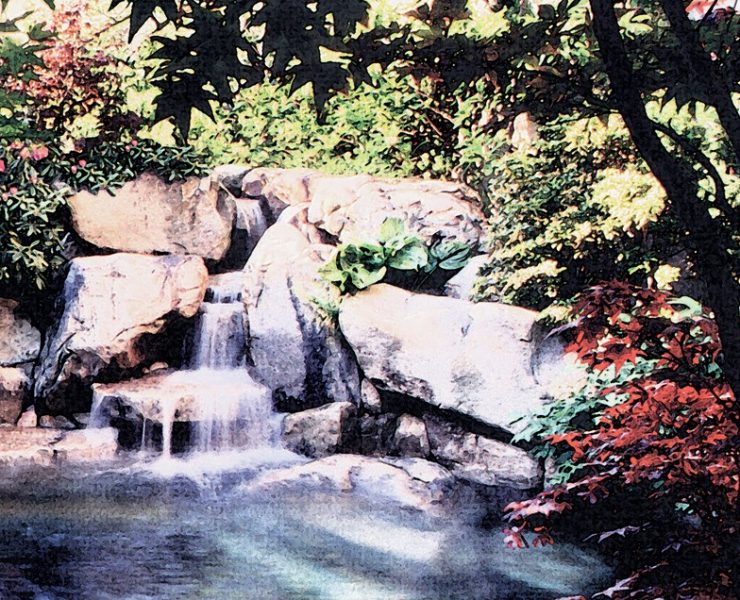
I believe that what we strive for in our watershapes is evident in the paintings and sculpture of the great masters. The harmony, the beauty, the drama, the excitement of the senses, the total captivation of the viewer create an experience we call great art. The more we can reflect on this work and use it as a lofty benchmark, the more effective our watershapes become. I've always believed that the best way to work at the highest level is to follow the tenets of

Just as every garden should reflect the aesthetic values of its owners and accommodate their lifestyle preferences, so too every watershape should reflect the nature, purpose and "meaning" of the garden it inhabits. If it's a Victorian garden, then the watershape should be of similar style - perhaps a blend of formal and natural elements with stone or brick accents. If the theme is "wild, romantic tangle," then cascades, blossom-laden pools and rambling roses may be in order. For its part, a simple, paved court may call for a