








Chicago

Projects in significant public spaces are rewarding on many levels, but they also carry their fair share of challenges, mostly in the forms of scheduling, coordination and communication. For us at Crystal Fountains (Concord, Ontario, Canada), these hurdles are beyond familiar: For decades, we've been a go-to working partner for fountain and interactive waterfeature projects around the world, from the Crown Fountain

Whenever I visit the area with any time to myself, I enjoy visiting the Art Institute of Chicago. Not only does the museum host a collection of artwork expansive enough to include Renaissance masters as well as cutting-edge Modernists, but it also has what may be the best museum shop I've ever encountered.
It'd be well worth the visit even if it didn't also have a wonderful waterfeature - the Fountain of the Great Lakes - on its west side.
I'm a sucker for fountains that make me think not only about how they work but also what they mean, and in this case the interpretation of the way the Great Lakes flow and interrelate leads to a few moments of interested reflection. It's not exactly literal, nor is it very complicated: It's just a charming an allegorical representation of five vast, interconnected lakes that contain more than a fifth of the world's fresh water.
I find it amusing that the fountain was controversial in its day. Some were upset because the imagery wasn't quite literal enough. Sure, if you're visualizing a map of the lakes it's a bit difficult to read the relationships of the five figures as a clear representation of the system, but that seems trivial.
And then there were objections because there's a certain amount of metallic breast on display; that, too, seems trivial in such a classical set of forms. (You have to wonder if, back in 1913, those same prudes ran around putting their version of sticky-notes all over any Rubens painting the museum might have been fortunate enough to acquire or borrow.)
Personally, my only complaint is that the fountain isn't where it was originally placed: In 1963, it was moved from a venue of much greater prominence to its current spot adjacent to what was then a new wing that had been added to the museum complex. The positioning isn't terrible, but I don't like the reflecting pool/fountain that now shoots jets of water up into the space: The big sculpture works better on its own!
As defects go, however, that's an easy one to ignore. So when you visit the Art Institute and its great museum shop, take a few extra steps and visit a wonderful fountain that tells a nice little story about the region and its heritage.
When I prepare my Travelogues, I always spend some time, usually midway through the process, looking at what's available on the Internet to support the basic observations I'm getting ready to offer. Often, for example, I'll confirm information I already have about designers or engineers or installers (and their clients), touching all the bases to get the details right. As important, I'm on the lookout for

It's been a number of years since I've managed to visit Chicago, but I want to get back sometime soon. After all, I have yet to see the Crown Fountain in person (let alone the rest of Millennium Park), and I haven't visited the Chicago Botanic Garden in more than 30 years! The last time I was in the Windy City with any time to spare, it was 2002 and I was attending
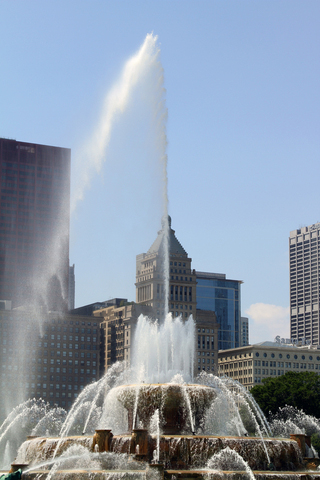
My family moved away from Chicago when I was just four years old, but I have three vivid, very specific memories of the place: icicles hanging from the eaves of our home in Evanston; the long freight trains that ran constantly on tracks at the far edge of the open field across the street; and Buckingham Fountain in downtown Chicago’s Grant Park. When I returned to the Windy City on business in the early 1980s (several years before I became directly involved with watershaping), it wasn’t to Evanston I went; instead, once I’d checked into my hotel on that bright spring day, I made a beeline to the
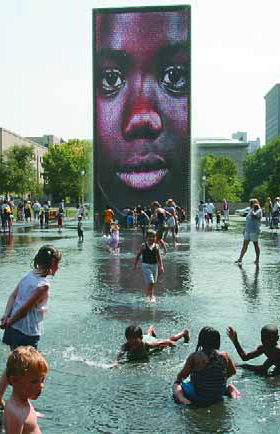
In July last year, the city of Chicago unveiled its newest civic landmark: Millennium Park, a world-class artistic and architectural extravaganza in the heart of downtown. At a cost of more than $475 million and in a process that took more than six years to complete, the park transformed a lakefront space once marked by unsightly railroad tracks and ugly parking lots into a civic showcase. The creation of the 24.5-acre park brought together an unprecedented collection of