








The Ocean’s Hidden Engine
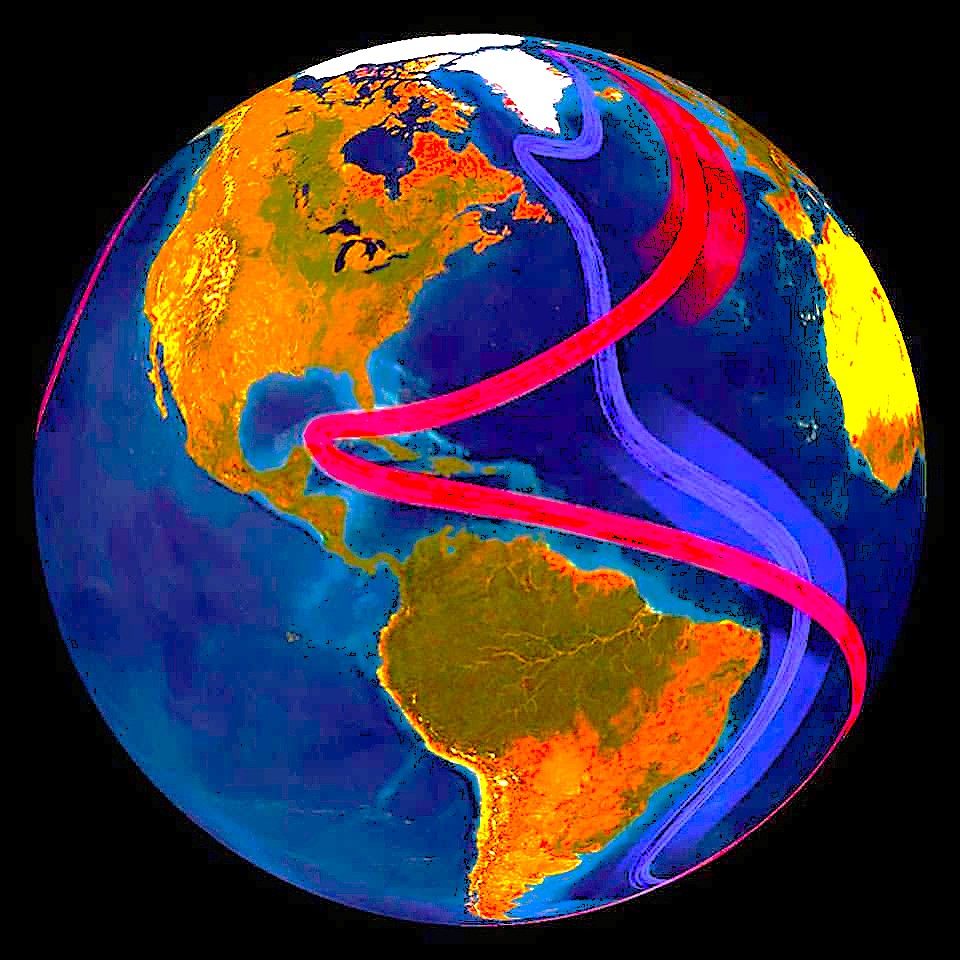
Far below the surface of the Atlantic Ocean, beyond the reach of wind and waves, a vast and patient machinery is at work. It does not roar or churn in ways we can easily see, yet it moves heat, salt, carbon, and life itself across the southern and northern hemispheres. Known as the Atlantic Meridional Overturning Circulation, or AMOC, it is one of Earth’s most consequential natural systems. It is also one of its most vulnerable.
By Eric Herman
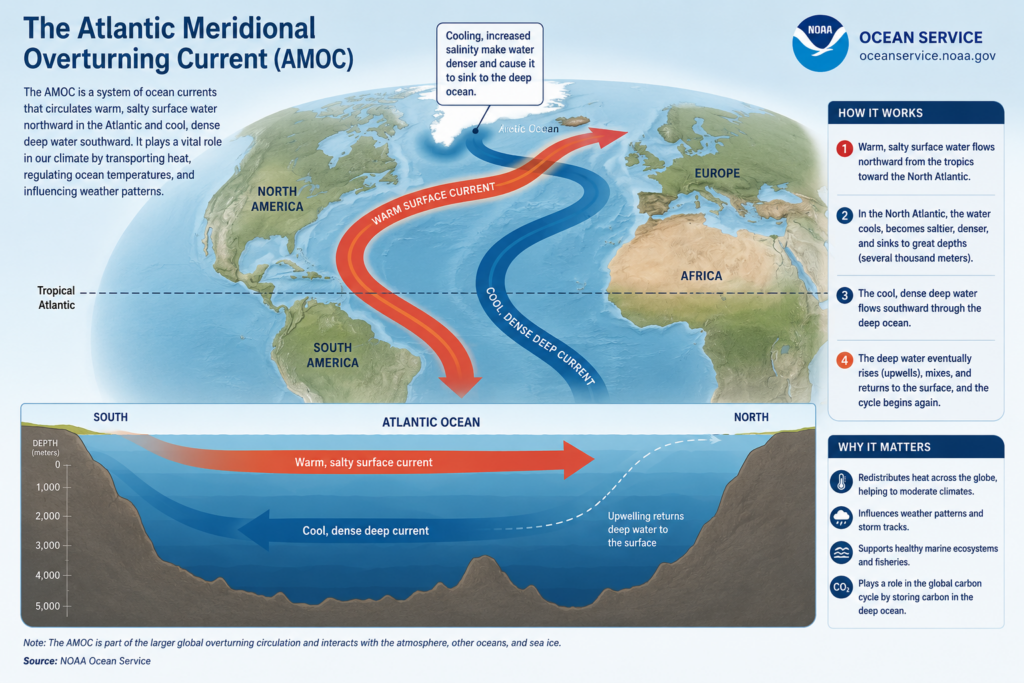
To understand the AMOC is to understand something fundamental about how the planet breathes. Warm, salty water flows northward along the ocean’s surface, part of a broad current system that includes the familiar Gulf Stream. As this water reaches the high latitudes of the North Atlantic, it cools. Cooling increases its density, and because it is already saline, it becomes heavy enough to sink thousands of feet into the depths.
There, it begins a long, slow journey southward, eventually rising again in distant parts of the world’s oceans before returning once more to the surface. This continuous overturning is far from a simple loop, but a three-dimensional circulation that links hemispheres and basins in a single, global system.
It is difficult to overstate the importance of this process. The AMOC carries immense quantities of heat from the tropics toward the North Atlantic, moderating climates along the way. It is the reason London’s winters are far milder than those of Labrador, despite their similar latitudes. It helps position rainfall belts, influences monsoons, and even shapes sea level along continental coastlines. It also acts as a planetary storage system, drawing carbon dioxide from the atmosphere into the deep ocean, where it can remain for centuries.
System Dynamic
For much of human history, this system was invisible, inferred only indirectly through climate and ocean observations. Serious scientific understanding began to take shape in the late nineteenth and early twentieth centuries, as oceanographers mapped temperature and salinity across the seas. After World War II, the theory of thermohaline circulation took hold, linking temperature and salt content to density-driven flow.
In recent decades, advances in satellite observation and the deployment of deep-ocean instrument arrays have allowed scientists to measure the AMOC more directly, revealing not a static system, but one that pulses, shifts, and responds to changing conditions.
That responsiveness is now the focus of intense concern. Evidence has been accumulating that the AMOC is weakening. Observational records and climate reconstructions suggest that its strength has declined since the mid-twentieth century and may now be at its lowest level in more than a thousand years. A persistent region of unusually cool water south of Greenland, often referred to as the “cold blob,” appears to be a visible signature of that slowdown. At the same time, high-resolution measurements reveal variability that is anything but smooth, including step-like changes that hint at deeper instability.
Saline Feedback Loop
The vulnerability of the AMOC lies in the delicate balance that allows surface waters in the North Atlantic to sink. That balance depends critically on salinity. As freshwater enters the ocean, whether from melting ice sheets, increased precipitation, or river discharge, it dilutes seawater and reduces its density. Water that is too fresh will not sink, and without sinking, the entire overturning process begins to falter.
This is where feedbacks come into play. A weaker AMOC transports less salt northward, which freshens the North Atlantic even further. That, in turn, weakens the circulation more. It is a self-reinforcing cycle, a feedback loop, and it is one reason scientists describe the AMOC as a tipping element. It does not simply respond in a linear fashion to gradual changes. Instead, it can cross thresholds, beyond which the system reorganizes abruptly into a very different state.
Paleoclimate records offer sobering evidence of this behavior. During the last ice age, abrupt climate shifts occurred over remarkably short timescales, sometimes within decades. These events are strongly linked to changes in ocean circulation, including the AMOC. They serve as reminders that the climate system is capable of rapid transformation when certain thresholds are crossed.
Recent research has sharpened the picture, though not necessarily the certainty. Some studies suggest that the AMOC could weaken dramatically over the course of this century, potentially losing nearly half its strength by 2100 under high-emission scenarios. Others indicate that while weakening is likely, a complete collapse within this century remains uncertain.
Changing Global Patterns
What has changed is the tone of the discussion. Collapse is no longer widely dismissed as a remote possibility. It is now considered a plausible outcome under continued warming.
If such a collapse were to occur, the consequences would be profound and far-reaching. Europe could experience significant cooling, even as global temperatures continue to rise. Storm tracks would shift, and rainfall patterns across the tropics could be disrupted, altering monsoons and affecting agriculture for billions of people.
Along the eastern seaboard of North America, sea levels could rise more rapidly as the redistribution of ocean mass responds to the weakening current. Marine ecosystems, long adapted to the nutrient flows sustained by overturning circulation, could be thrown into disarray. At the same time, the ocean’s ability to absorb carbon dioxide would diminish, accelerating the pace of atmospheric warming.
And yet, for all its gravity, the situation is not without agency.
Is There Time
The forces driving the AMOC toward instability are closely tied to human activity, particularly greenhouse gas emissions. Warming accelerates ice melt and intensifies the hydrological cycle, both of which increase freshwater input into the North Atlantic. Slowing or reversing these trends offers the most direct path to preserving the circulation.
There are no practical engineering solutions capable of restoring the AMOC once it has collapsed. Prevention, in this case, is not just preferable to cure, it is likely the only viable option.
The question of whether it is already too late does not yield a simple answer. The best available science suggests that it is not. The AMOC has not yet crossed a definitive tipping point, and there is still time to influence its trajectory. But the margin for error is shrinking. The system is already changing, and the signals of stress are evident.
What makes the AMOC so compelling, and so unsettling, is that it embodies a different kind of climate risk. Much of climate change unfolds gradually, measured in degrees and millimeters. The AMOC represents the possibility of something else entirely, a threshold beyond which change accelerates and the familiar patterns of climate give way to something new.
It is the ocean’s hidden engine, steady and immense, and for now, still running. Whether it continues to do so may depend less on the deep waters of the Atlantic than on decisions made far above them, on land, in the span of a single human lifetime.
Images courtesy of the National Oceanic and Atmospheric Administration.
References:
National Oceanic and Atmospheric Administration (NOAA)
“Atlantic Meridional Overturning Circulation (AMOC)”
A foundational scientific overview explaining the structure, mechanisms, climate significance, and observational science behind the AMOC system.
Intergovernmental Panel on Climate Change (IPCC)
Climate Change 2021: The Physical Science Basis
Chapter 9 includes extensive analysis of observed and projected AMOC changes under climate warming scenarios. This is one of the most authoritative references on the subject in climate science.
Nature Publishing Group
Caesar, L., Rahmstorf, S., Robinson, A., Feulner, G., & Saba, V. (2018).
“Observed fingerprint of a weakening Atlantic Ocean overturning circulation.” Nature, 556, 191–196. (A landmark peer-reviewed paper presenting evidence that the AMOC has weakened substantially over the twentieth century.)
American Meteorological Society
Buckley, M. W., & Marshall, J. (2016).
“Observations, Inferences, and Mechanisms of the Atlantic Meridional Overturning Circulation: A Review.” Reviews of Geophysics, 54(1), 5–63.