








runnels

Editor's Note: Welcome to our new department, Open Waters. It's a space we're dedicating to the variety of the watershaping world. Here you'll find a rotating series of blogs, videos, book and resource reviews, stories about charitable works in the industry, and travelogues including this discussion from Watershape University's Lauren Stack about her recent visit to the Tulsa Botanic Gardens. The property sits on a plateau known as "Persimmon Ridge" -- a 170-acre site likely a gift from a benefactor with roots in

It may not happen as often as I'd like, but every once in a while a project comes along unexpectedly and turns out to be just fantastic. In this case, I was referred by a pool builder I didn't know to a home designer/builder I didn't know, either. The pool builder had found me via the Internet after the designer/builder had let him know that she was interested in finding a talented pool designer who could help carry her residential projects to a new level. He'd liked what he'd seen on my web
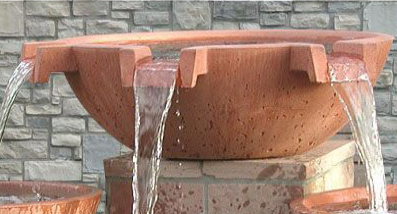
Fountains Unique (Laguna Hills, CA) has added Tuscany Spill Bowls to its line of decorative…
The trouble with conventional approaches is that they can take the creativity out of watershape designs. Almost always, for example, spas are placed directly adjacent to or within the walls of a swimming pool. For a couple generations now, this has led designers to specify open spillways to move water from the spa into the pool, thereby creating a single body of water so far as

It’s not unusual for watershapers to have their signatures. For some, these noteworthy effects extend from their educations and personal design preferences, while for others, inspiration comes from distinctive qualities found in local landscapes or from tailoring designs to suit the characters of their clients. In our case, we at Hydroscapes (Fountain Hills, Ariz.) pull on all of the above and more in our design work. Through the years, we’ve done a lot of projects associated with Contemporary-style architecture – a specialty, perhaps, but not what we’d call a signature. This work has led us to invest lots of time in studying modern masters including Frank Lloyd Wright and John Lautner – and, as they did, in learning about Japanese garden design and the work of the great Craftsmen architects such as Greene & Greene. Those influences flow neatly together for us because all of those designers embrace simplicity of line and form as well as elegance in the use of colors and materials. It doesn’t hurt that these legacies suit our personal tastes as a husband-and-wife design team – and it helps even more that a majority of our clients these days seem to start with similar ideas in mind: They want

My dictionary defines a rill as a small stream cut by erosion. In the practice of watershaping, however, that colorful little word has been stretched to cover manufactured channels in which we artfully move water from one place to another. These often-subtle effects have a history dating at least to the 5th Century BC, when Persian kings demonstrated their power over nature by using rills to bring water – a symbol of fertility as well as a practical means of cooling architectural spaces – from rivers and aqueducts to their palaces. These early rills were observed and adopted by Muslim designers and engineers who rose to eminence in the Middle East more than a millennium later and were carried along as Islamic influence spread through India, North Africa and, eventually, Spain, where signature elements of Moorish architecture are still seen today in the famous