








hydraulics

It’s not unusual for watershapers to have their signatures. For some, these noteworthy effects extend from their educations and personal design preferences, while for others, inspiration comes from distinctive qualities found in local landscapes or from tailoring designs to suit the characters of their clients. In our case, we at Hydroscapes (Fountain Hills, Ariz.) pull on all of the above and more in our design work. Through the years, we’ve done a lot of projects associated with Contemporary-style architecture – a specialty, perhaps, but not what we’d call a signature. This work has led us to invest lots of time in studying modern masters including Frank Lloyd Wright and John Lautner – and, as they did, in learning about Japanese garden design and the work of the great Craftsmen architects such as Greene & Greene. Those influences flow neatly together for us because all of those designers embrace simplicity of line and form as well as elegance in the use of colors and materials. It doesn’t hurt that these legacies suit our personal tastes as a husband-and-wife design team – and it helps even more that a majority of our clients these days seem to start with similar ideas in mind: They want

The death in 2002 of the granddaughter of former U.S. Secretary of State James Baker brought the problem of suction entrapment to unprecedented public attention. That incident - and others in which bathers have become stuck atop pool drains - have led to development of new legislation and pool-construction standards as well as increased awareness of the hazard. To me and some others, however, the new rules represent a reactive, regulatory solution to what might better be approached as a proactive matter of technology and engineering. In stepping back and carefully examining the anatomy of these terrible accidents, it becomes clear that, although steps can be taken to reduce risks, there is no single approach, given current design and construction practices, that will eliminate risks altogether. So far, in fact, all of the industry education and media attention we've witnessed is focused on solutions that at best mitigate entrapment hazards but do not eliminate them. These are not, unfortunately, approaches that lead us to complete and effective solutions. As an industry, we have not grappled with what I see as the true, addressable core of the issue
The death in 2002 of the granddaughter of former U.S. Secretary of State James Baker brought the problem of suction entrapment to unprecedented public attention. That incident - and others in which bathers have become stuck atop pool drains - have led to development of new legislation and pool-construction standards as well as increased awareness of the hazard. To me and some others, however, the new rules represent a reactive, regulatory solution to what might better be approached as a proactive matter of technology and engineering. In stepping back and carefully examining the anatomy of these terrible accidents, it becomes clear that, although steps can be taken to reduce risks, there is no single approach, given current design and construction practices, that will eliminate risks altogether. So far, in fact, all of the industry education and media attention we've witnessed is focused on solutions that at best mitigate entrapment hazards but do not eliminate them. These are not, unfortunately, approaches that lead us to complete and effective solutions. As an industry, we have not grappled with what I see as the true, addressable core of the issue
The death in 2002 of the granddaughter of former U.S. Secretary of State James Baker brought the problem of suction entrapment to unprecedented public attention. That incident - and others in which bathers have become stuck atop pool drains - have led to development of new legislation and pool-construction standards as well as increased awareness of the hazard. To me and some others, however, the new rules represent a reactive, regulatory solution to what might better be approached as a proactive matter of technology and engineering. In stepping back and carefully examining the anatomy of these terrible accidents, it becomes clear that, although steps can be taken to reduce risks, there is no single approach, given current design and construction practices, that will eliminate risks altogether. So far, in fact, all of the industry education and media attention we've witnessed is focused on solutions that at best mitigate entrapment hazards but do not eliminate them. These are not, unfortunately, approaches that lead us to complete and effective solutions. As an industry, we have not grappled with what I see as the true, addressable core of the issue

It's common knowledge that getting into any body of water - large, small, natural, man-made - involves a certain level of risk. Despite all the healthful benefits of water recreation, despite all of the immense psychological and even spiritual appeal of even being in water's presence, the brutal truth is that, in certain conditions, simply
It's common knowledge that getting into any body of water - large, small, natural, man-made - involves a certain level of risk. Despite all the healthful benefits of water recreation, despite all of the immense psychological and even spiritual appeal of even being in water's presence, the brutal truth is that, in certain conditions, simply

It’s a project I won’t soon forget, believe me. In the April 2008 issue of WaterShapes, I offered the first of what ultimately will be three articles on an enormously ambitious project I began working on more than two years ago. In that span, I’ve found myself taking whatever solace I can from the fact that everyone who’s become involved with the project (or has even heard about it in any detail) concedes that it’s probably the most complicated backyard watershape they’ve ever encountered. Last time, I covered the scope of the project in general terms, outlining the design-development process and rolling through some of the more intricate details of the early construction phases. This time, we’ll move along to take a close look at the multiple water systems and effects and the hydraulic approaches needed to make them all work. (In thinking things through in preparation for writing this article, I began to suspect that there might be enough here to fill a small book; being a merciful soul, however, I’ll stick to the key points and keep things moving.) To recap briefly: The project features

Every once in a while, a project comes along that gives you a chance to step up and demonstrate your company’s capabilities. The construction of the swimming pool seen here was just that kind of exercise for our firm. Located in Potomac, Md., the property is just west of Washington, D.C., in an exclusive neighborhood remarkable for the outstanding caliber and quantity of its watershaping and landscaping projects. We became involved here through a custom homebuilder who was remodeling the property and wanted to do something special in the backyard. This represents a perfect example of how our firm, Alpine Pool & Design of Annandale, Va., thrives in this market. Through the years, we had already worked not only with the homebuilder, but also with the architect as well as the landscape architect. When it came time to consider watershape construction, all three recommended us for the job – testimony to the fact that ever since we opened shop in 1986, we’ve done all we can to establish a reputation for high-value collaboration as part of a community of like-minded designers and contractors. We pride ourselves on being able to execute the most challenging designs and
It’s an unfortunate fact that landscape architects receive little or no formal education in watershaping while they’re in school. As a result, where the typical landscape architect’s irrigation plan will show every pipe, fitting, wire and component for a given project, that same project’s pool plan will carry almost no detail at all. This phenomenon begs the question: Why don’t our colleges and universities do more to educate landscape architects about watershaping? The answer to this question causes me double pain, because I know full well that
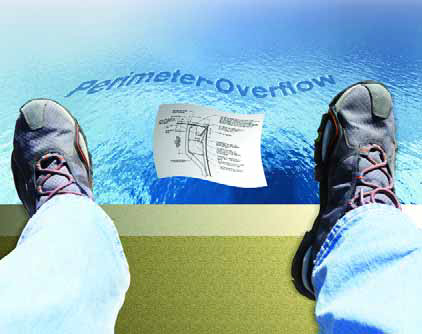
As we discussed last month, perimeter-overflow details are among the most distinctive and challenging of all features in today’s custom pool market. In March’s column, we defined the different types of these edge designs, then described the complex, exacting process of building a knife-edge overflow system. This time, we’ll get into the hydraulic finesse needed to make these systems work. This includes everything from calculating bather surges to sizing the plumbing and surge tanks needed to make these effects function