








foundations

As watershapers, we all have one common goal in mind: We don't ever want our concrete pools, spas, fountains or waterfeatures - whatever it is we've just finished building - to move at any time, in any way at all. This is true no matter the physical or geological circumstances. On a slope, on the flat, elevated above a parking garage or set on rock or in sand or clay, wherever we're working, we follow

The past couple weeks have seen an unusual number of good-news items cross my desk. Let’s start with the Association of Pool & Spa Professionals’ announcement of the formation of World of Recreational Water, a new foundation that will promote the sustainable use of recreational water worldwide. Back when Eric Herman and I spent many long hours
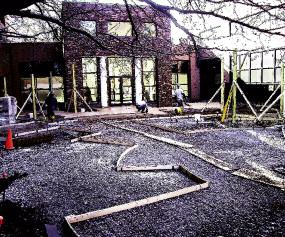
Have you ever noticed how often the costliest part of a project turns out to be something that will ultimately be hidden from view? This happens quite frequently in projects involving any sort of slope, where the piers and grade beams beneath swimming pools, for example, can cost far more than the rest of the overall project. In my own work, I’ve noticed this budgetary quirk most frequently when it comes to retaining walls, where providing the foundation they need to withstand the forces applied by a slope can be startlingly extensive and expensive. It’s not what you’d call glamorous work, but it certainly is important – and will vanish completely from view. Most often, we’re called on to build these walls when
In just about every profession, it seems that there’s one thing or another that goes unnoticed and underappreciated because it is overshadowed by more visible or sensational elements. In the watershaping and landshape trades, for example, I see foundations as being among these unsung details despite their obvious significance. They’re so important that I always talk with my clients about them and the role proper preparation plays in the success of everything atop them. After all, I say, a home can have wonderful tile work in the kitchen, but it really won’t be worth much unless
As an extension of my landshaping work in Iowa, I currently serve on a committee formed not long ago by the Johnson County Heritage Trust. Our mission is simple but immense: to preserve as much of the natural environment as possible. The committee was formed in response to development of a new subdivision in a high-quality oak/hickory forest in which relatively few invasive species had gained footholds. Our immediate task was to compile a list of acceptable plants for this community as well a list for the whole county. Of course, this story is much larger than

Whether laid flat, stacked, loose or alone as an accent, stone is an integral part of most garden designs. Whether used in walls, paths or decks and no matter the type, it's a versatile material and knowing a bit about using it (and how to avoid problems) can be a tremendous help to any landshaper. These days, stone is quarried and can be moved to where you are from anyplace around the globe, provided your clients are ready to pick up the eye-popping cost of freight. But almost every area also has local sources of supply - a big advantage not only because you and your clients can easily see what you're getting, but also because local stone tends to fit better into naturalistic landscapes. Beyond the practicalities of

For centuries, the Mediterranean gardens of Italy, France, Greece and Spain have put sun-thriving plants on beautiful display in dry environments. The Greek isles flourish with wildflowers whose colors become more vivid against the bleached background, while Spanish gardens combine the fragrant blossoms of citrus trees and the fragile pink blooms of Almond trees with open, arid landscapes. Italian and French gardens present more formal atmospheres, incorporating boxed and trimmed trees with trellises and pergolas draped with vines. Each area has its distinct style, but the main elements of these gardens are the same, with the hot sun being the primary common factor. As is revealed, however, in Designing and Creating a Mediterranean Garden by the English artist Freda Cox, it is possible to cultivate

An important and complex factor in any business is the daily paperwork required to function properly. A couple of years ago I decided to bring all the paperwork, forms and filing practices for our business up to legal speed, so I enrolled in a class on Mechanic's Lien laws and processes. The class was run by a law firm, and the first thing they said was that everyone is intimidated by forms and make it all too complicated. They advised us to

Just as nature inspires art, I believe that art can inspire landscape professionals to "paint" themes and moods into gardens. Claude Monet's work is a striking example of this unconventional relationship between art and landscaping, a connection explored fabulously in Monet the Gardener (Universe Publishing, 2002), a collaboration between Sydney Eddison, who writes and lectures on gardens; and Robert Gordon, a leading authority on French Impressionism. Together, they delve into Monet's obsession with his famous garden at Giverny, describing his fixation on flowers and the struggles he had in creating his lily pond. Included are letters from Monet, members of his family, journalists and writers from the late 1800s, all of them chronicling the artist's choices among