
Solar Desalination


Desalination has always carried a stubborn tradeoff: produce precious freshwater from the sea, then figure out what to do with the concentrated brine left behind. Now, researchers have demonstrated a solar-powered approach that produces freshwater while turning dissolved salts into solid, recoverable minerals. Still in its early stages, the technology could redefine how we think about desalination, waste, and water scarcity.
By Eric Herman
For decades, desalination has carried an awkward contradiction. The ocean contains enough water to dwarf human needs, yet turning seawater into freshwater has traditionally meant producing another problem in the process: concentrated saltwater, or brine.
A new solar-thermal desalination system developed by researchers at the University of Rochester suggests a different possibility. Instead of separating fresh water from seawater and sending the remaining concentrated brine back into the ocean, the system removes the dissolved salts as solids, creating freshwater while capturing nearly all of the minerals in the original seawater.
The technology remains at the proof-of-concept stage. But its combination of solar energy, self-cleaning materials and zero liquid discharge offers an intriguing glimpse at what desalination could become.
The Brine Problem
Desalination is already an important component of water supply in many water-stressed regions, including parts of California and the Middle East. The most widely used technology, reverse osmosis, forces seawater through membranes at high pressure. The membranes allow water molecules to pass while rejecting most salts and other dissolved substances.
It works remarkably well, but there is a price. A desalination plant does not turn all of its intake water into freshwater. A substantial fraction leaves the process as concentrated brine containing salts and other materials removed from the seawater. The Rochester researchers note that conventional reverse-osmosis and thermal desalination systems can produce substantial brine streams. Their published research identifies brine discharge as both a technical and environmental concern.
The concern is not simply that the water is salty. Concentrating seawater also concentrates everything else dissolved in it. When brine is discharged into the ocean, the resulting plume can create localized increases in salinity and changes in water chemistry that may affect marine organisms. The environmental consequences depend on the composition of the discharge, its concentration, the method and location of discharge, and local ocean conditions.
Eliminating the liquid waste stream therefore changes the equation considerably.
A Different Way to Desalinate
The Rochester approach does not use reverse osmosis. Instead, it uses sunlight to evaporate water directly from a specially engineered metal surface. The key component is a thin panel made from black metal whose surface has been structured using femtosecond lasers. A femtosecond is one quadrillionth of a second, allowing the laser to create extremely small structures on the metal surface.
Those structures perform two jobs. First, they make the metal exceptionally effective at absorbing sunlight. Second, they make the surface “superwicking,” meaning water spreads across it in an extremely thin film rather than forming droplets.
Seawater is drawn across the heated surface. Solar energy is absorbed by the black metal, causing water to evaporate. The water vapor can then be collected as freshwater, while the dissolved salts remain behind.
That basic idea is hardly new. Solar evaporation has been studied for years as a way to purify water. The difficult part is what happens to the salt. Anyone who has watched a kettle develop a white mineral crust understands the problem. When water evaporates, dissolved minerals remain behind. Eventually they can form deposits that interfere with heat transfer, clog surfaces and shut down a desalination system.
That problem becomes particularly challenging with actual seawater because seawater contains much more than sodium chloride. Calcium, magnesium and other minerals can form hard, dense deposits.
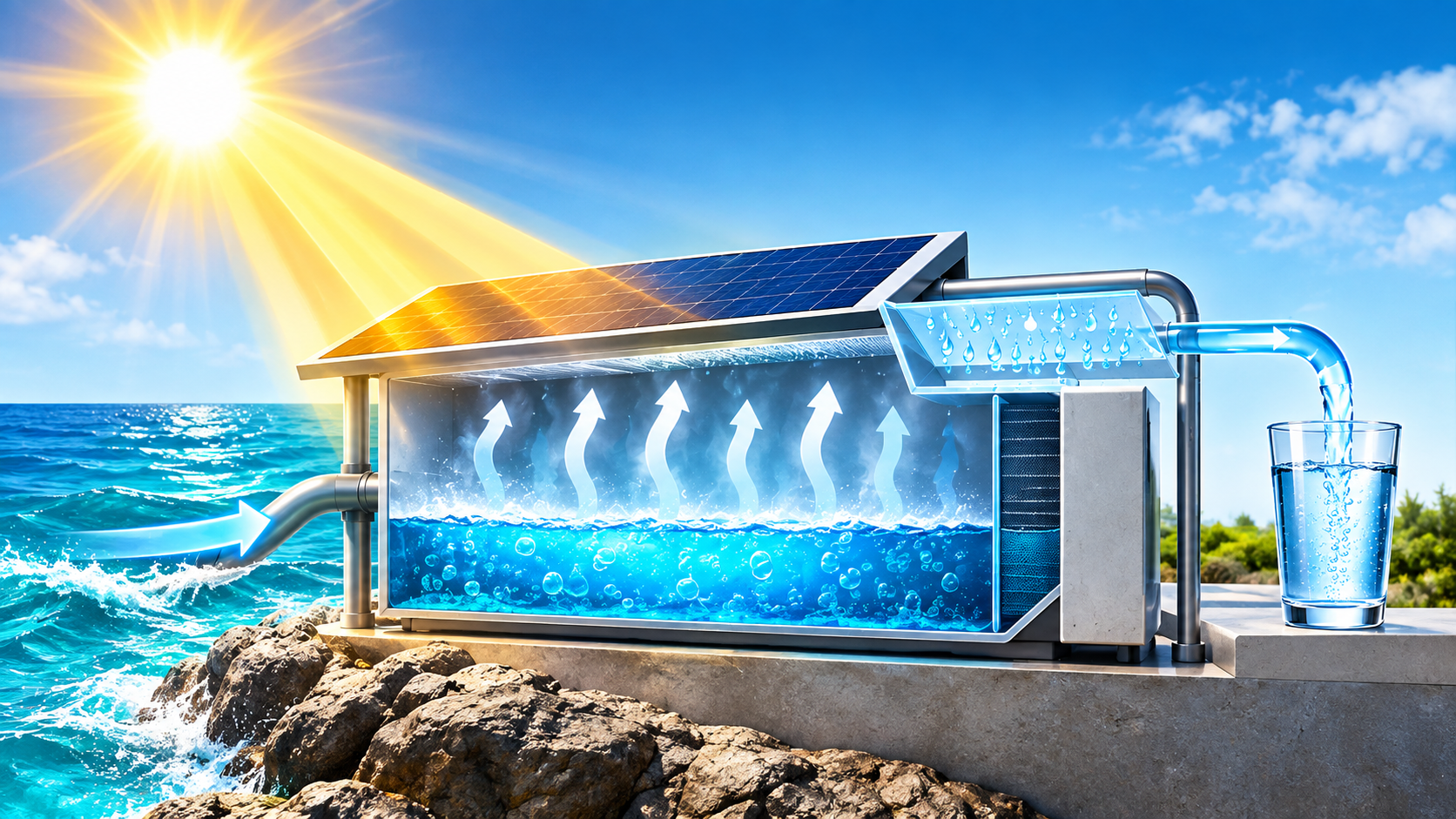
The Rochester researchers designed microscopic grooves into their laser-treated metal surface to solve that problem.The system uses a phenomenon known as the coffee-ring effect. When a drop of coffee dries, particles migrate toward the edge of the droplet, leaving behind the familiar dark ring. The researchers use a similar physical effect to move crystallizing salts away from the active evaporation area.
Instead of allowing the salt to form a crust across the portion of the panel where water is evaporating, the surface geometry directs the crystals toward passive areas at the edges, where they can be collected. In other words, the device does not merely desalinate water. It manages the salt while it is doing it.
The researchers tested the system with actual seawater collected from the Pacific, Atlantic and Indian oceans. They reported continuous operation without maintenance for periods of weeks, with the surface directing crystallized minerals away from the active evaporation area.
From Waste to Resource
The results are notable for a laboratory-scale demonstration.
Under one-sun illumination, the system produced an average evaporation rate of approximately 1.76 kilograms of water per square meter per hour, equivalent to roughly 1.76 liters per square meter per hour. The researchers reported about 74 percent solar-to-vapor conversion efficiency and a salt-harvesting rate of approximately 61.7 grams per square meter per hour.
Most strikingly, they reported nearly 100 percent extraction of the dissolved salts from the seawater. The significance of those numbers is not that a small laboratory panel is suddenly capable of supplying a city. It isn’t. The significance is that the researchers demonstrated a solar-thermal process that simultaneously produced freshwater and converted the dissolved minerals into a recoverable solid rather than a liquid waste stream. That is a fundamentally different approach to the desalination problem.
The solid material left behind could itself have value. Salt is the obvious example. But seawater contains numerous dissolved minerals, some of which have industrial value. That possibility becomes particularly interesting when considering lithium.
In a related 2026 study, the Rochester team developed a variation of its solar-thermal system designed to selectively capture lithium ions. The researchers incorporated hydrogen titanate nanoparticles into the laser-structured metal surface. The material acts as a lithium-ion sieve, selectively taking up lithium while rejecting competing ions.
Using water from Utah’s Great Salt Lake, the researchers reported approximately 50 percent lithium extraction efficiency. The resulting eluate contained a dramatically higher proportion of lithium, potentially making it suitable as feedstock for subsequent refining. That is an important distinction: the technology is not simply attempting to make desalination less harmful. It is exploring whether desalination can become a form of resource recovery.
The concept is attractive because the economics of water treatment have always been tied to what happens to the material removed from the water. If a waste stream can instead become a useful product, the entire process potentially changes.
Why Solar Energy Matters
Another important feature is the energy source. Conventional reverse osmosis requires substantial electrical energy to pressurize seawater. Thermal desalination requires heat. The Rochester technology uses solar radiation directly as the energy source for evaporation.
That opens the possibility of desalination systems operating with little or no dependence on conventional grid electricity, particularly in regions with abundant sunlight. It also creates an interesting geographic coincidence. Some of the places experiencing severe water shortages are also among the world’s sunniest regions.
Solar energy, seawater and freshwater demand therefore occupy the same physical map. That does not mean solar desalination automatically solves the water problem. Large-scale systems still require infrastructure, water intake systems, freshwater collection and distribution, land, materials and maintenance. And sunlight is intermittent, meaning a commercial system would have to account for nighttime, clouds and seasonal variation.
But the ability to drive evaporation directly with sunlight could reduce one of the major energy burdens associated with conventional desalination. Eliminating liquid brine could represent a significant environmental advantage, but “zero brine” should not be confused with “zero environmental impact.”
The first issue is the salt itself. The Rochester process essentially changes the physical form of the waste from liquid to solid. Nearly all of the dissolved salts are still there. They have to be collected, stored, transported, processed or sold. If the minerals have no practical market, a facility could still face a substantial solids-management problem.
The second issue is seawater intake. Any large desalination facility has to move enormous quantities of seawater through its system. Intake design can affect marine organisms, particularly plankton and small organisms drawn toward intake structures. A new desalination technology would still need an environmentally responsible approach to collecting seawater.
There is also the question of scale. The Rochester experiments were conducted with relatively small devices. The researchers describe the design as inherently scalable, but demonstrating scalability in a laboratory is different from building a commercial facility capable of producing millions of gallons of freshwater every day.
A commercial system would have to demonstrate long-term durability, consistent freshwater quality, resistance to biofouling and contamination, reliable salt collection, practical manufacturing costs and performance under changing weather conditions. Those questions remain open.
A Different Water Future
The larger significance of the research may therefore be less about replacing today’s desalination plants tomorrow and more about changing the way engineers think about desalination. For decades, the basic model has been relatively straightforward: Seawater in → freshwater out → concentrated brine out. The Rochester research suggests another model: Seawater in → freshwater out → minerals recovered. That is a subtle but potentially important shift.
The difference is especially relevant as communities look for additional water supplies without continually drawing down rivers, reservoirs and groundwater. Desalination offers access to an essentially inexhaustible source of water, but its energy requirements, infrastructure costs and brine management have limited where and how it can be deployed.
A system that uses sunlight, avoids chemical pretreatment, continuously removes salt from its evaporation surface and produces solid minerals rather than liquid brine addresses several of those challenges simultaneously.
The researchers’ peer-reviewed study, published in Light: Science & Applications, describes the system as additive-free and brine-discharge-free and reports testing with real ocean water from three oceans. That is promising science. It is not yet a commercial water solution. Still, water scarcity is increasingly forcing engineers to reconsider a fundamental assumption: that getting freshwater from the ocean necessarily means creating a difficult waste stream.
If that assumption can ultimately be discarded, the ocean may become a considerably more useful component of the world’s freshwater infrastructure. And for an industry built around moving, treating, heating, filtering and managing water, that is a development worth watching.
Sources: The primary research is Luheng Tang et al., Light: Science & Applications (2026), supplemented by the related Rochester lithium-recovery study in Journal of Materials Chemistry A and the University of Rochester’s September 2026 research release.