


A Legacy in Curves
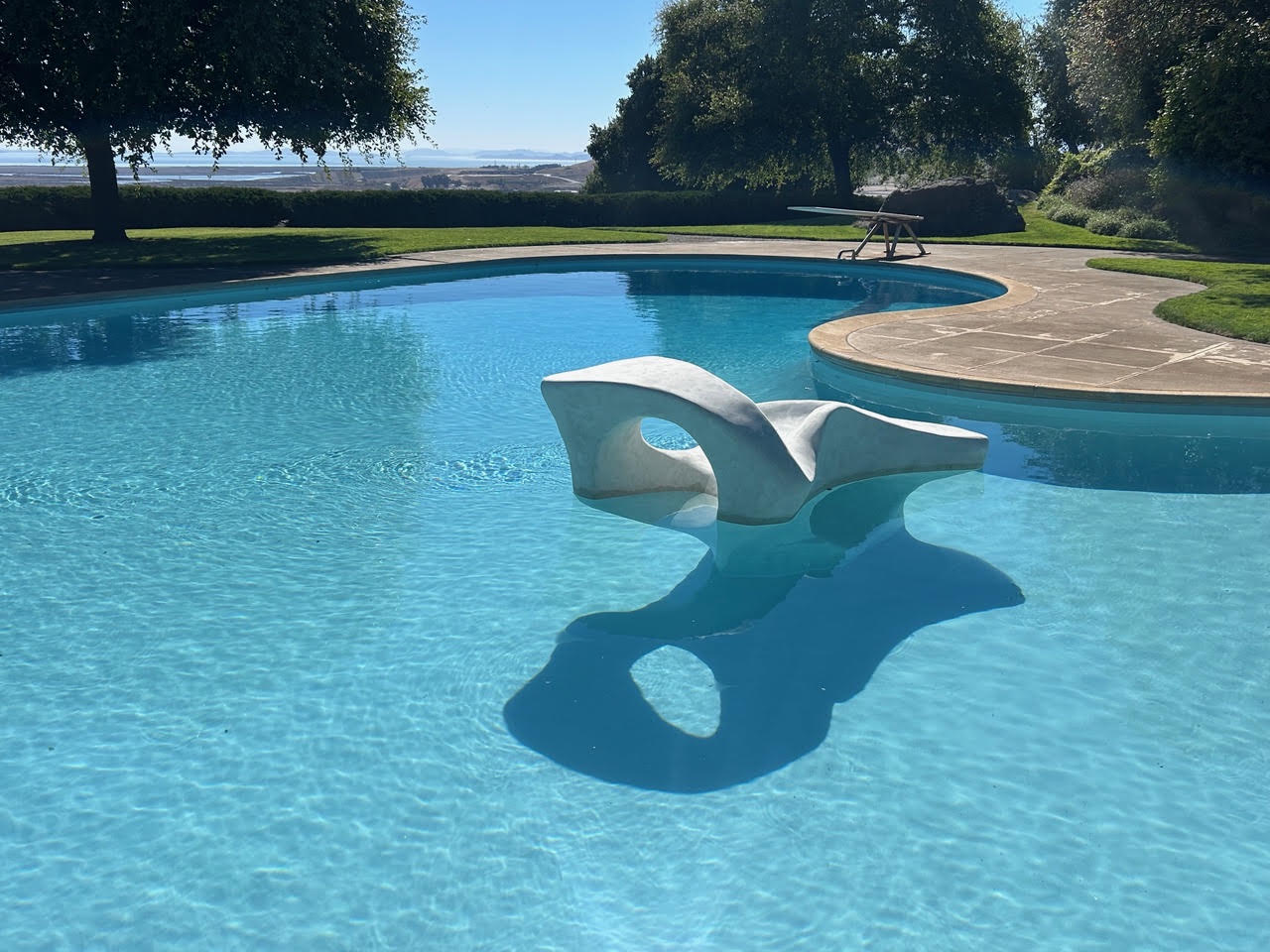
Refurbishing Northern California’s legendary Donnell Ranch pool required technical expertise, historical sensitivity, craftsmanship, restraint, and a sense of responsibility to preserve an American design icon.
By Chuck Baumann
Some swimming pools stay with you long after you have left the job site. They become part of your personal history, shaping the way you think about design, construction, and what it means to build something that lasts. The swimming pool at Donnell Ranch in Sonoma, California, is one of those pools for me. Refurbishing it was a professional privilege, but it was also a deeply personal experience that connected my own family history in the pool business to one of the most influential swimming pools ever built.
When Creative Environments was invited to work on the pool, we understood immediately that this was a project unlike an ordinary renovation. The homeowners, members of the Donnell family, wanted a builder who shared their commitment to preserving the property’s design legacy and the integrity of a historic work of art.
That understanding shaped everything we did.
A Pool That Changed Everything
Designed by landscape architect Thomas Church, with the involvement of a young designer, Lawrence Halprin, the Donnell Ranch pool helped redefine what a residential swimming pool could be. Its freeform geometry departed from the conventional rectangles that had long dominated pool design. The result was a composition that seemed to belong naturally to the landscape, with curves that were both visually compelling and structurally effective.
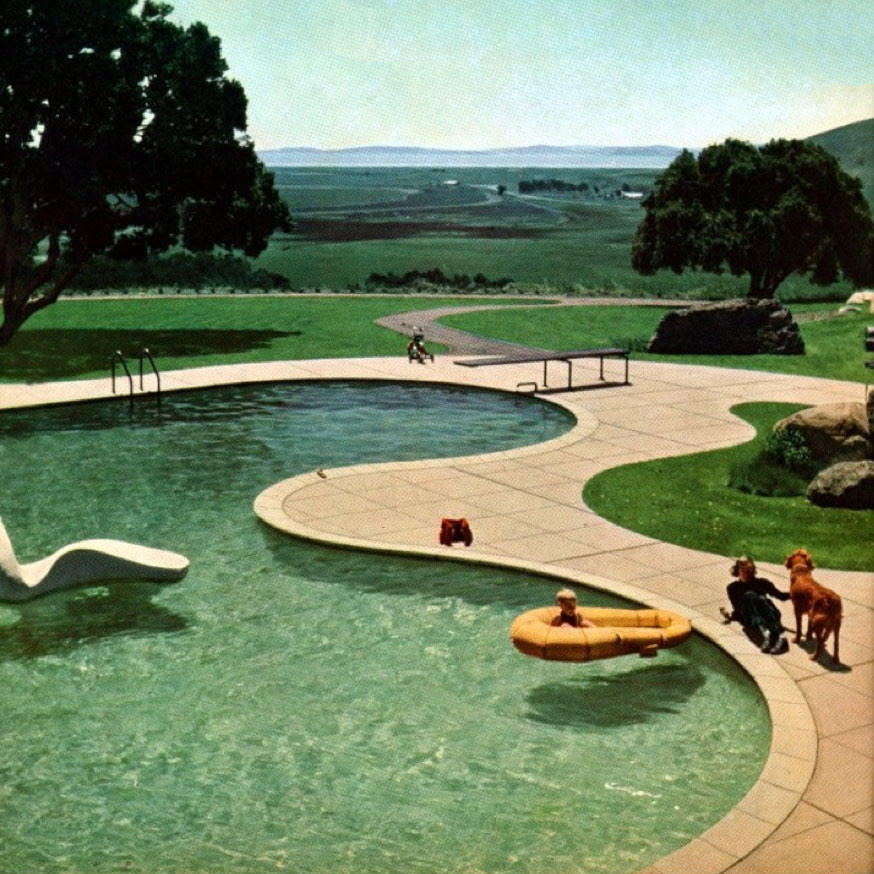
The pool became an inspiration for generations of designers and builders, particularly during the postwar housing boom, when swimming pools became increasingly popular features of the American backyard. As homeownership expanded, rising property values gave many families the opportunity to finance backyard improvements through home equity.
The pool industry was ready to meet that demand. Companies such as Anthony Pools and Blue Haven developed business models that could deliver swimming pools to a growing middle-class market. Volume construction helped make pools accessible to far more homeowners than ever before.
But there was another side to that story. As builders began producing pools in ever-greater numbers, the industry sometimes lost sight of the relationship between design, craftsmanship and the conditions of the individual site. It was a decline in quality that would plague the industry for decades, and is in some respects still with us today.
The Donnell Ranch pool offered a different model. It demonstrated that a swimming pool could be an architectural statement, an integral part of a landscape and a source of inspiration for future generations. Its curves were part of a carefully considered design that gave the pool its distinctive character.
I grew up in an industry where pools were built by people who took pride in their work. My father was building pools in the 1950s and early 1960s, and the influence of projects such as Donnell Ranch reached far beyond their original settings. Years later, I remodeled a pool my father had built for a friend’s family. Looking at that pool again, I was struck by how closely its design resembled the Donnell Ranch pool.
I began to appreciate how much that earlier design had influenced my father and, through him, the work I would eventually do myself. Its impact had traveled through the industry and into my own life. That made the opportunity to work on Donnell Ranch especially meaningful.
The fact that my son, Nicco Baumann, was integrally involved from the outset in his role as owner of Creative Environment made the process a truly profound pleasure, knowing that this project was all about connecting the past with the future.
Respect Before Renovation
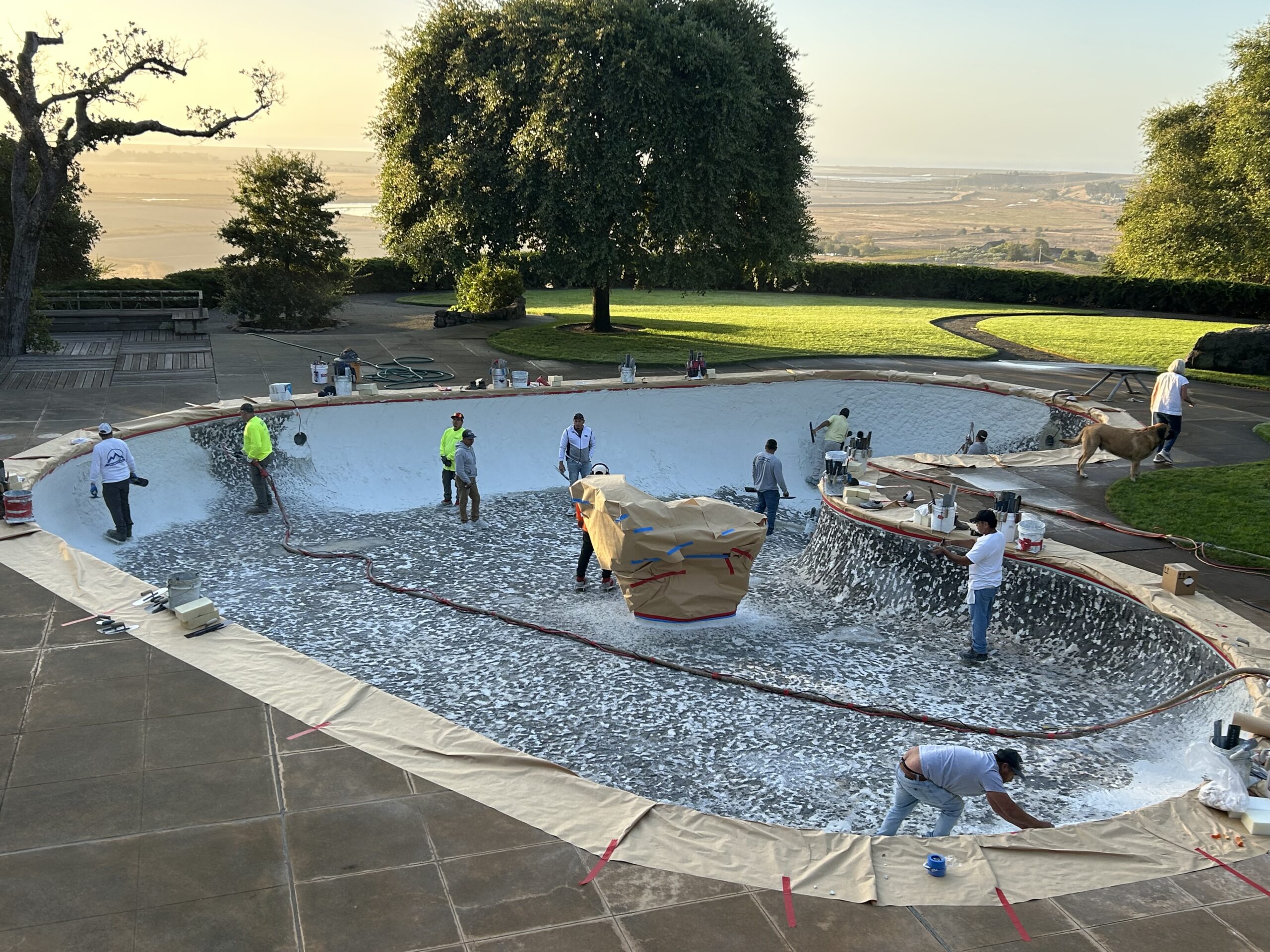
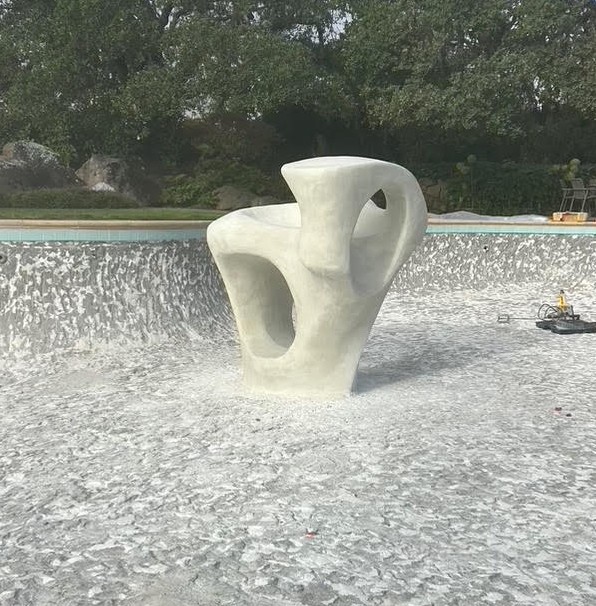
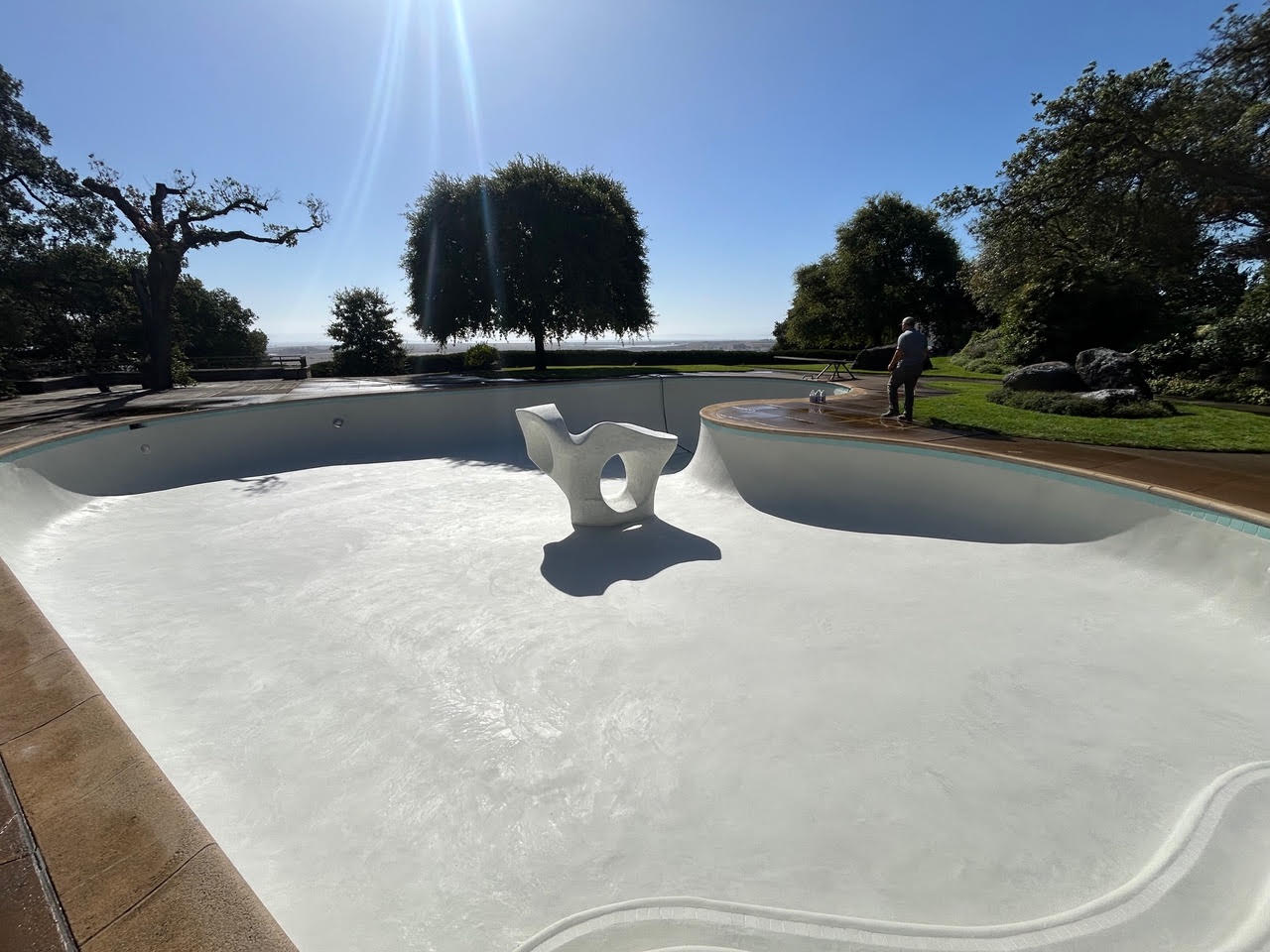
The scope of our work was relatively limited. We replastered the pool, replaced the underwater lights, cleaned mineral scale from the waterline tile and refinished the sculptural art object that occupies the pool. Yet every one of those tasks required careful decisions because the objective was to preserve the original character rather than improve the pool according to contemporary tastes.
Completed in 1949, we were not the first to lay hands on the original. The family had already experienced a disappointing renovation. Several years earlier, another plaster company had attempted to refinish the art object, applying plaster without adequately researching the materials needed for a piece that was partly submerged and partly exposed to the air.
The result was cracking, gaps and a deteriorating finish. Every time the owners looked at the pool, they were reminded of a repair that had failed to respect the object they valued so much. That experience had understandably made them cautious about hiring another contractor.
I have always believed that when you work on a project with genuine historical or personal significance, you have to put yourself in the owner’s position. You need to understand what the project means to them before you start talking about what you think needs to be done. This is their sacred cow. You don’t walk in and start acting like a cowboy, announcing that everything needs to be changed because you think you know better. You listen, you learn and you respect what is already there. Out of that respect comes confidence. The owners begin to trust that you understand their priorities and will make decisions accordingly.
I didn’t approach Donnell Ranch as a problem that needed solving. I approached it as a project I cared about, for people I wanted to help, involving a pool that had played an important role in the history of my own profession. That distinction makes all the difference.
The Art of Getting It Right
One of the most important decisions we made was to bring Burkett’s Pool Plastering into the project. Their experience, starting with founder Rob Burkett and manager Shaun Goldberg, technical knowledge and willingness to research the details were invaluable, particularly when it came to refinishing the art object.
The challenge was finding a material that could withstand the wet/dry condition. We weren’t interested in applying something that might look acceptable for a few months. We needed a durable, appropriate finish that would respect the original artwork and remain comfortable to the touch.
Burkett did the necessary research and identified a solution that met those requirements: We used a multicoat polymer enhanced Pondkote. Also most importantly, we put on several layers and then polished the finish. The refinishing was successful, and the object could once again function as an integral part of the pool’s composition
Their flexibility was equally important elsewhere on the job. When we removed the old lighting, we encountered electrical conduit that had been configured for the original fixtures. The new LED lights required modifications, including new conduit and rewiring for two lights. We also needed to modify the pool returns to accommodate adjustable eyeball fittings. Those fittings would allow us to direct the water flow after the pool was running, helping keep the pool clean and properly circulated.
These details might sound routine to someone looking at the finished pool, but they are exactly the sort of issues that can complicate a restoration. You don’t always know what you will find until you begin removing old materials. The ability to adapt without compromising the project is a measure of a contractor’s professionalism.
Eighty Years of Endurance
One of the most remarkable things about the Donnell Ranch pool was the condition of its underlying structure.
The pool was approximately 80 years old, yet the gunite shell remained remarkably sound. The plaster had begun to deteriorate, with areas of spalling and delamination, but the structural concrete itself showed no cracking. That is extraordinary when you consider the pool’s age, its size and the seismic activity that has affected Northern California over the decades.
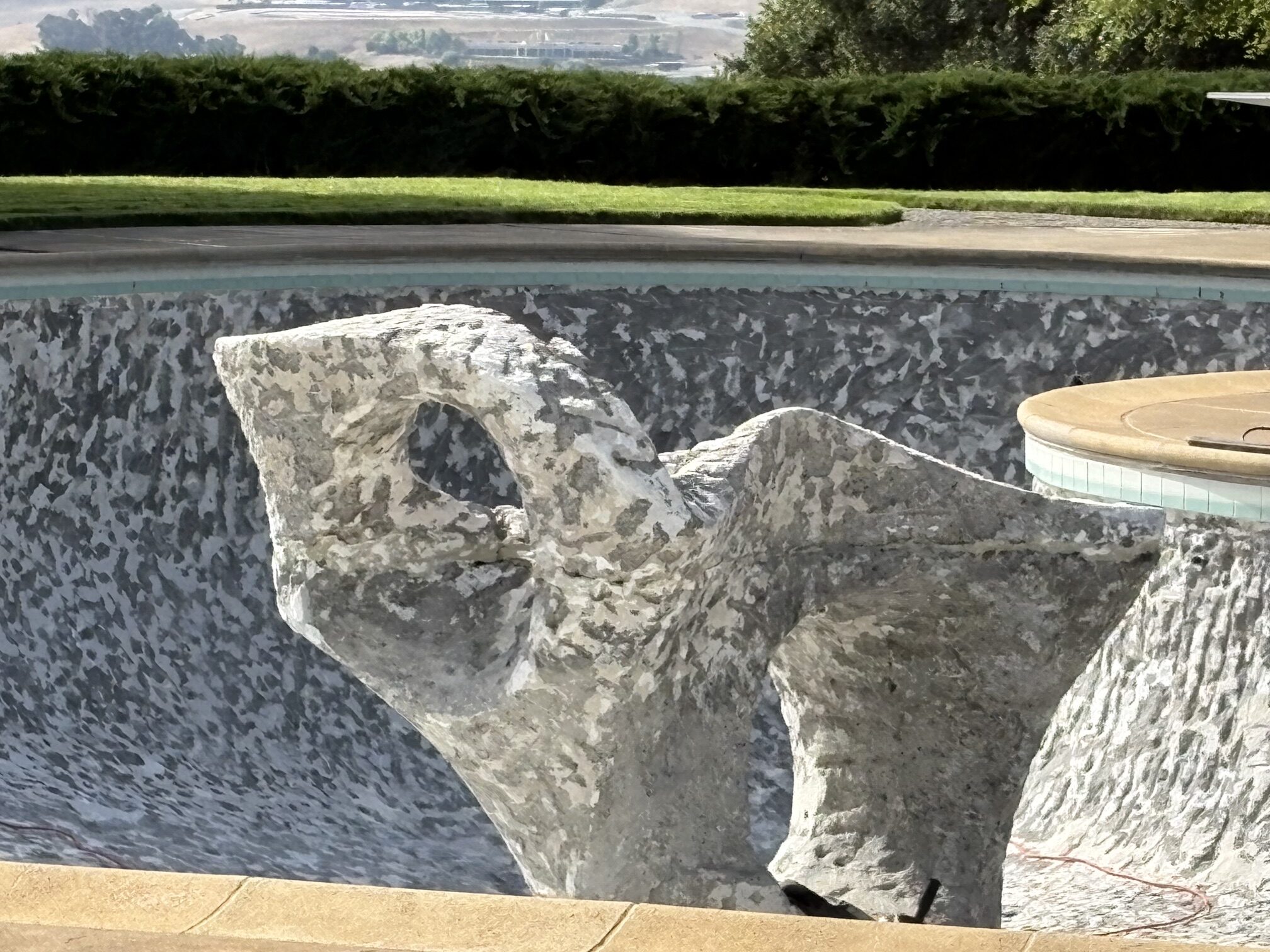
As I looked at the exposed shell after the old plaster was removed, I noticed the reinforcement. Instead of the conventional reinforcing bar arrangements we are accustomed to seeing today, the pool contained heavy reinforcing mesh. In several places, the steel was relatively close to the surface, but the structure had held together remarkably well.
I also examined the gunite itself. We did not establish a laboratory measurement of its compressive strength, so I wouldn’t claim a specific number. What we could observe was a shell that had performed exceptionally well over the course of its life.
I believe the pool’s geometry contributed to that performance. The relationship between the walls and floor, including the generous radii where those surfaces meet, creates a continuous form rather than a collection of sharp corners. Curved structures can distribute loads differently from rectangular ones, and the geometry of this pool is part of what makes it so compelling.
The shell had endured decades of ground movement, yet we found no significant cracking. Some sections of the surrounding concrete decking had lifted by an inch or so, but even much of that material remained in good condition. The pool was a reminder that thoughtful design and sound construction can work together to create something with remarkable longevity.
Vintage White
The plaster was another matter. Like most plaster finishes, it had reached the end of its useful life.
During my father’s career, it was not unusual for pool plaster to last 30 years or longer. When the surface eventually needed attention, builders sometimes acid-washed it rather than stripping it completely. Older renovation practices often involved applying a new finish over an existing surface or bond coat.
Today, conventional plaster finishes commonly require renewal after roughly 10 to 15 years, although actual service life varies with materials, installation, water chemistry and maintenance. When an existing finish has deteriorated substantially, we generally remove it and prepare the underlying gunite to receive the new material.
At Donnell Ranch, we needed a finish that would perform well without overwhelming the original design. We used Wet Edge’s Altima finish. The material itself was only part of the equation. The quality of a plaster finish depends heavily on the people installing it, their preparation, their application techniques and their understanding of the product. I have known the Burkett team for years, and I consider them among the finest plastering professionals in our industry. Their reputation is built on the way they approach the work, not simply on the materials they use.
The crew also incorporated Set and Cure from Microglass into the plaster mix. The product was originally promoted as a topical application, but contractors began experimenting with adding it directly to the batch. That approach is intended to reduce water penetration through the finished plaster as it ages.
The precise benefits depend on the formulation, installation and curing conditions, but the principle is important: finish technology continues to evolve, and experienced installers are constantly learning how to use those materials more effectively.
At the Waterline
The waterline tile at Donnell Ranch is a beautiful example of a material that has become part of a place’s identity.
It is the familiar six-inch ceramic tile in a soft aqua-blue shade, a color that complements the water and the surrounding landscape without competing with either. In the years when pools such as this were built, choices were far more limited than they are today. That simple tile was a standard selection, but here it became an essential part of the pool’s visual character.
Decades of exposure to the ranch’s well water had left a mineral deposit along the waterline. The tile above the water had developed a hazy, chalky appearance. Below the waterline, the original color remained remarkably clear. Once the pool was drained, the contrast was striking.
We had to decide how best to clean the tile without damaging it. Burkett proposed bead blasting with glass beads, a process that can remove mineral deposits while treating the underlying surface more gently than more aggressive methods. The technique must be selected carefully because some modern tiles can be etched or damaged by blasting.
In this case, the treatment worked beautifully. The deposits were removed, and the original ceramic tile regained much of its appearance. It was one of those details that might escape notice if you were unfamiliar with the pool’s history. To me, it was a perfect example of what restoration should accomplish. We didn’t need to replace the tile with something newer or more fashionable. We needed to reveal the beauty that was already there.
The coping presented a different challenge. I used a simple sounding technique, tapping the material and listening for the hollow tone that indicates a loss of bond, we identified sections where the coping was no longer firmly attached. That raised the question of whether to remove and reset it. The answer was no.
The coping had accumulated decades of weathering, wear and patina. Removing it would have introduced a significant risk of breakage, and replacing damaged sections would have required us to match the original color, texture and aged appearance. Even a technically sound repair could have left conspicuous differences around the pool.
The same reasoning applied to portions of the concrete decking that had shifted slightly over the years. Replacing those sections might have corrected the unevenness, but there was no guarantee we could reproduce the original finish.
Sometimes preservation means accepting the small imperfections that come with age. A historic structure does not need to look newly manufactured to be beautiful. In many cases, those signs of time are part of its character. The objective is to distinguish between deterioration that threatens the pool’s performance and aging that contributes to its authenticity. That distinction requires experience, judgment and, above all, restraint.
Restoring the Beauty of the Pool
There is another reason I care so much about the way we build and renovate swimming pools. For much of my career, I have wanted to help restore the public’s appreciation of what a swimming pool can bring to a home and a family.
During the period when the industry was expanding rapidly, concerns about swimming pool safety and liability began affecting the real estate market. Some real estate professionals became reluctant to show homes with pools because they viewed them as a liability.
The concerns were growing even before pool safety became the subject of the broader public discussion that would follow. Diving-board accidents and other risks were contributing to a negative perception of residential swimming pools. That attitude troubled me because it overlooked the tremendous positive role a pool can play in people’s lives. A well-designed swimming pool can bring a family together. It can provide exercise, recreation, relaxation and a connection to the outdoors. It can transform a backyard into a place where people spend time together and create memories that last for generations.
The answer to safety concerns is to take safety seriously, build responsibly, educate owners and maintain pools properly. We should never minimize the risks, but neither should we allow those risks to define the entire experience. The Donnell Ranch pool represents everything I believe the industry can accomplish when design, construction and purpose come together. It is a beautiful example of how water can become an integral part of a landscape, and how a swimming pool can be far more than an amenity.
The work we do as builders has consequences that extend well beyond the day we finish a project. A pool may outlast its original owners, influence other designers and become part of the history of a place. We have a responsibility to recognize that possibility.
The Value of Caring
When I look back on our work at Donnell Ranch, I am proud of the technical results, but the greatest satisfaction comes from knowing we respected what the pool means to its owners. We helped restore the owners’ confidence in the people they hire to care for something they love. That may be the most important part of the entire project.
In our business, it is easy to get caught up in schedules, budgets, materials and margins. Those things matter. We all have companies to operate and employees to support. But none of that should obscure the fact that we are working on something that belongs to someone else, often something that carries a great deal of personal meaning.
The Donnell Ranch pool is a historic landmark in residential swimming pool design. Its influence reaches across generations of builders, including my own family. To have the opportunity to preserve it was an honor I will always appreciate.
I want people to understand that the work we do is about more than making a nickel or a dime. It is about caring enough to bring that commitment to every project, whether it is a modest backyard pool or an internationally recognized design icon.
You have to care about the people who trust you, the materials you work with, the details that others may never notice and the finished result that will remain long after you have moved on to the next job. If we do that consistently, we can build an industry that takes pride in its work, earns the confidence of its customers and creates swimming pools that enrich people’s lives.
And perhaps, 80 years from now, someone will walk into a pool we built, pick up a handful of earth, examine the structure and appreciate that the people who made it cared enough to get it right.
Chuck Baumann is founder of Creative Environments, a pool construction firm based in Alamo, CA. Coming from a family of three generations of pool professionals and further back, area settlers dating back to the California Gold Rush, Chuck began working at his father’s pool store at age five in the 1950s. Among his many career achievements, he was a pioneer in the hot tub/spa retail segment, a founding member of Carecraft, and an active member of industry associations throughout his seven-decade career.