








The Cognitive Current
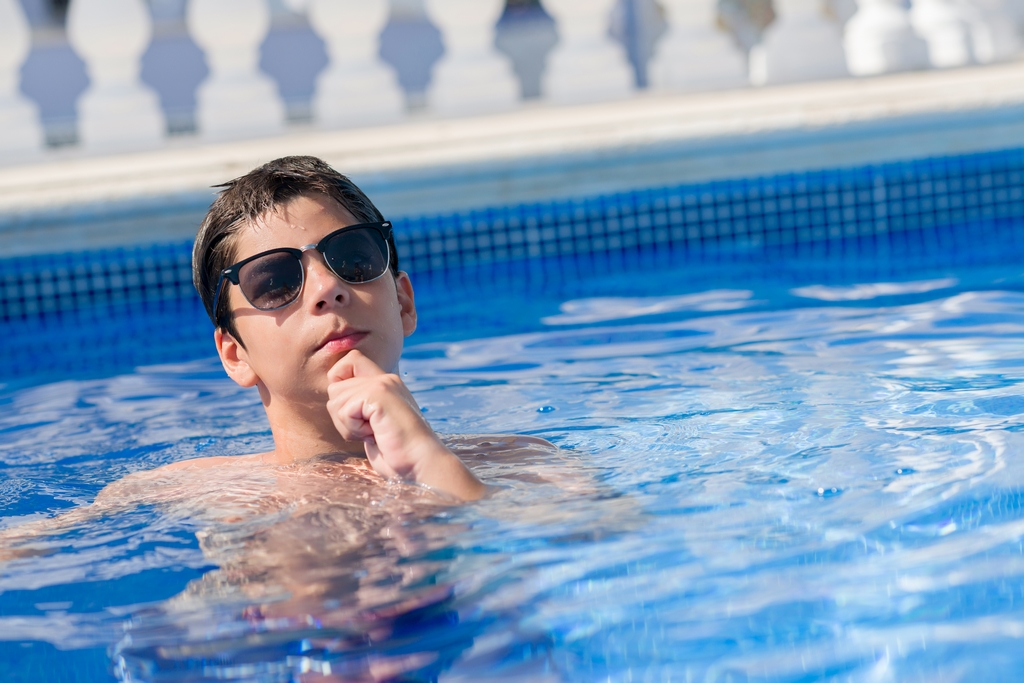
Recent research from Australia strongly suggests that swimming is not only great for child safety and fitness, but it also offers powerful cognitive benefits in key learning areas including mathematics, language arts, problem-solving, and overall learning readiness. Here’s a deep dive into the illuminating findings.
By Eric Herman
For generations, swimming lessons have been pr0moted primarily as a matter of water safety. The logic is obvious: the earlier a child becomes comfortable and competent in the water, the better prepared that child may be to respond to an aquatic emergency.
But research led by Professor Robyn Jorgensen, originally at Griffith University in Australia, suggests that the value of early-years swimming may extend considerably further. Her work points to a striking association between participation in swimming and a broad range of cognitive, linguistic, mathematical, motor and school-readiness skills.
The findings are particularly interesting because they concern children under five, a period when the foundations for later learning are developing rapidly.
Jorgensen’s four-year project, Early Years Swimming: Adding Capital to Young Australians, involved a survey of approximately 7,000 children under five in Australia, New Zealand and the United States. The Australian component included observations of more than 120 swimming lessons in 40 swim schools. To move beyond the limitations of parent-reported developmental milestones, the researchers also conducted more intensive assessments of a core group of approximately 176 children between three and five years old.
The results were sufficiently pronounced to surprise the researchers themselves. “While we expected the children to show better physical development and perhaps be more confident through swimming, the results in literacy and numeracy really shocked us,” Jorgensen said.
The important point is that the research does not establish that swimming itself causes children to become more intelligent. Rather, it found that children participating in early-years swimming were often significantly ahead of normative populations on a range of developmental measures. Jorgensen’s academic work explores how the swimming environment might provide experiences that build what she calls “capital” that children can carry into other learning environments.
A Remarkable Cognitive Profile
Perhaps the most frequently cited results from the Griffith research concern the language, memory, mathematics and instruction-following abilities of the swimming children.
Among the intensively assessed children, the average results were:
- 11 months ahead in oral expression
- 6 months ahead in mathematics reasoning
- 2 months ahead in brief reading
- 17 months ahead in story recall
- 20 months ahead in understanding directions
The children tested had an average age of approximately 50 months, making some of those differences particularly striking.
Jorgensen described the findings as “absolutely staggering,” particularly the differences in story recall and understanding directions.
These categories are worth examining individually because they reveal something important about what happens during a swimming lesson. A child in the pool is not simply learning to propel the body through water. The child is listening, remembering, sequencing, responding to visual and verbal cues, controlling movement, judging distance, counting, communicating and adapting to a constantly changing physical environment.
In other words, swimming can become a remarkably dense learning environment.
Learning to Listen
One of the most intriguing findings was the advantage in understanding directions.
This makes intuitive sense when considering the structure of a well-designed swim lesson. A young child may be asked to sit on the edge, wait for a cue, enter the water, turn around, reach for a wall, kick, roll onto the back, retrieve an object or move toward an instructor.
Each task requires the child to receive information, interpret it, remember it and translate it into physical action.
Jorgensen identified this characteristic of swimming early in the research project. In an interview with ABC, she observed that swimming can be one of a young child’s first encounters with formal instruction. Children are asked to “sit down, look at me, listen to my instructions” and then act on what they have heard.
That sequence closely resembles the basic behavioral demands of a classroom.
A child entering kindergarten already accustomed to listening for instructions, waiting for a turn and translating spoken directions into action may possess a useful form of learning capital.
This is one of the central ideas in Jorgensen’s research. Her work draws on the sociological framework of Pierre Bourdieu, using the concept of capital to describe knowledge, behaviors and skills that can provide advantages in particular social and educational environments. In her 2012 paper, Under-fives swimming as a site for capital building: Supporting and enhancing transitions, she argued that swimming lessons can provide young children with forms of knowledge and behavior that become valuable when they enter formal education.
Memory in Motion
The 17-month advantage reported in story recall may be even more revealing.
Memory is fundamental to learning. Children must remember sounds, words, sequences, rules and relationships. They must retain information long enough to use it in a new context.
Swimming lessons continually exercise this process.
A child learns that a particular verbal instruction corresponds to a particular movement. The child remembers the sequence of movements and gradually combines them into a more complex skill. Songs, rhymes, repetition and demonstrations reinforce the information. Jorgensen’s research suggests that children participating in early swimming were particularly strong in story recall.
It would be premature to conclude that swimming directly improves memory capacity. The more defensible interpretation is that the swimming environment gives young children repeated opportunities to practice listening, remembering and reproducing sequences of information.
Those are precisely the kinds of behaviors that become important when children begin formal schooling.
Mathematics in the Pool
The mathematical findings are another intriguing part of the research. The intensively assessed swimming children were, on average, six months ahead of the normal population in mathematics reasoning.
Jorgensen and colleague Peter Grootenboer subsequently examined swimming as a potential environment for developing “mathematical capital.” Their work describes swimming lessons as an environment in which children encounter mathematical concepts that can transfer to school contexts.
The pool is full of mathematical relationships. Children encounter numbers when counting repetitions, kicks or breaths. They experience distance when reaching for a wall or swimming toward a target. They encounter sequence, timing, order, position, direction and comparison.
Even simple instructions can contain mathematical ideas: go to the second step, reach for the red object, kick five times, move forward, turn around or retrieve the object at the bottom.
These experiences do not resemble a traditional mathematics lesson, but they provide children with opportunities to experience mathematical relationships physically. That distinction matters.
Young children often learn abstract concepts through concrete experiences. Before “distance” becomes a mathematical term, a child can experience the difference between something that is close and something that is far away. Before sequencing becomes an academic concept, a child learns that one action must happen before another.
The swimming environment can therefore provide a physical context for concepts that later become symbolic.
Language Development
Language is another area in which Jorgensen’s findings are particularly compelling. The swimming cohort averaged 11 months ahead in oral expression and two months ahead in brief reading.
Again, the potential explanation may lie partly in the nature of the instructional environment. Swimming lessons are highly verbal. Instructors name body parts, movements, directions, objects and actions. Children hear the same vocabulary repeatedly and are expected to respond to it.
There is also an important social dimension. Children communicate with instructors and parents. They observe other children. They hear questions, instructions, songs and explanations. They learn words associated with actions and objects, then use those words themselves.
The pool therefore becomes a place where language is attached to physical experience. “Kick” is no longer simply a word. It is an action. “Turn” has a physical consequence. “Under,” “over,” “behind,” “toward” and “away” become spatial relationships that the child can experience rather than merely hear.
This combination of language and movement may help explain why swimming children demonstrated stronger oral-expression scores.
Visual-Motor Learning
The benefits identified by Jorgensen’s team were not limited to conventional measures of intelligence or academic achievement. Swimming children also performed significantly better in visual-motor skills, including activities such as cutting paper, coloring and drawing lines and shapes. The final report also identified advantages in gross-motor stationary skills, including balancing, standing on one foot, imitating movements and performing sit-ups.
This is important because early education depends heavily on the connection between perception and movement. A child must look at a shape and reproduce it. The child must coordinate eyes and hands to use scissors. The child must control the hand sufficiently to draw a line.
Swimming develops a different but related form of motor organization. The child must coordinate arms, legs, head position, breathing and body orientation while simultaneously responding to visual and verbal information.
The resulting physical experience may contribute to a broader repertoire of motor control. Interestingly, the Griffith report also found areas in which the swimming children did not outperform normative populations. Object manipulation, including some ball-handling skills, was one such area.
That qualification is significant. It demonstrates that the findings were not simply a case of swimming children being universally more advanced in every developmental category.
Executive Skills Before School
Taken together, the findings point toward another category of development: what educators today would broadly associate with executive functioning and school readiness.
A young child in a swimming lesson must pay attention, remember instructions, inhibit impulses, wait for a turn, follow a sequence and adapt behavior to a particular environment. These are foundational classroom behaviors.
The child who learns that the instructor’s signal means “stop” is practicing behavioral inhibition. The child who remembers a sequence of movements is practicing working memory. The child who waits for a turn is practicing self-regulation. The child who adjusts a movement after receiving feedback is practicing cognitive flexibility.
Jorgensen’s research does not claim that swimming lessons are a substitute for early education, nor does it establish that swimming directly produces these executive skills. But the structure of the swimming environment provides repeated opportunities to practice them. That may be one reason the ability to understand directions emerged as such a strong finding.
The Physical Brain Connection
There is also a larger developmental question surrounding physical activity and cognition.
Swimming is unusual among children’s activities because it combines whole-body movement with an unfamiliar physical environment. Water changes the child’s relationship with gravity, resistance, balance and body position. Every movement produces a different sensory response.
A child must continually integrate sensory information with motor commands. Where is my body? Where is the wall? Which way am I facing? How far do I need to reach? When should I breathe? What did the instructor just tell me to do?
That combination of sensory processing, movement and attention makes swimming a particularly rich motor-learning environment.
Jorgensen’s research deliberately looked beyond swimming proficiency to examine the broader “capital” children might acquire through participation. Her work argues that early swimming can create learning opportunities that extend beyond the immediate physical skill being taught.
Swimming and the Transition to School
Perhaps the most consequential implication of the research is what it suggests about the transition into formal education.
Jorgensen’s 2016 peer-reviewed article, Early years swimming: a way of supporting school transitions?, examined testing results from 177 swimming children between three and five years old. The paper concluded that the swimming children were often significantly better than normative populations, suggesting that the swim environment may be “adding capital” that could position children favorably for the transition to school.
That transition involves far more than knowing letters and numbers. A child entering school must learn how to operate within a structured environment. There are rules, routines, instructions and expectations. Children must interact with adults outside the family, cooperate with peers, communicate their needs and regulate their behavior.
Swimming lessons can provide practice with many of these behaviors years before the first school bell rings. This may be especially relevant because swimming can begin at an unusually young age. As Jorgensen noted during the original research project, swimming is one of the early childhood activities that can introduce children to formal instruction before many other organized physical activities are developmentally accessible.
The Equity Question
There is an important caveat to the findings.
The study found differences across socioeconomic groups, but it also reported that swimming children in all four socioeconomic groups performed better than the normative population on the relevant measures. Jorgensen consequently identified early-years swimming as potentially important for children from lower socioeconomic backgrounds.
At the same time, access to quality swimming lessons costs money, requires transportation and depends on the availability of appropriate facilities and instructors. Jorgensen and Grootenboer explicitly raised questions about equity and the possibility that swimming could further advantage children who already have greater access to educational and recreational resources.
That creates a fascinating policy question. If swimming provides developmental experiences that can help prepare children for school, should access to quality aquatic education be considered part of early childhood development rather than simply a recreational expense? The research does not answer that question definitively. It does, however, make the question considerably harder to ignore.
What the Research Does and Does Not Prove
The enthusiasm surrounding the Griffith findings sometimes gets reduced to the catchy claim that “swimming makes kids smarter.” That is stronger than the evidence supports.
Jorgensen’s study was observational rather than a randomized controlled trial in which children were assigned to swimming or non-swimming groups. Families who enroll children in swimming may differ from families who do not in ways that influence development. Parents may have different educational backgrounds, resources, expectations or attitudes toward organized learning.
The researchers attempted to address some of these concerns through a large sample, socioeconomic comparisons, lesson observations and more intensive standardized testing. The final report also acknowledged areas where swimming children did not demonstrate an advantage.
The strongest conclusion is therefore not that swimming automatically increases intelligence. It is that regular participation in early-years swimming is associated with a surprisingly broad range of developmental advantages, many of which are directly relevant to later learning. That distinction makes the research more interesting, not less.
The Pool as a Classroom
Perhaps the most useful way to think about Jorgensen’s work is to stop viewing the swimming pool as a place where children learn only how to swim. It can also be a classroom without desks.
The curriculum is movement. The vocabulary is physical. The lessons involve repetition, sequencing, memory and problem solving. The teacher gives instructions and the child must listen. The child must remember. The child must act. The child receives feedback and tries again.
Mathematics can emerge through counting, distance, sequence and spatial relationships. Language develops through instruction, description and communication. Memory is exercised through repeated sequences. Visual-motor skills develop through coordinated movement. Self-regulation is practiced through waiting, listening and responding. Problem solving emerges as children learn how to position their bodies, negotiate the water and accomplish new tasks.
And beneath all of it is the physical experience of moving through an environment that behaves differently from the world on land. Jorgensen’s research offers a compelling reason to look at early swimming through a wider lens. The lesson at the pool may last 30 or 45 minutes, but the learning being practiced can extend well beyond the pool deck.
The most important finding may therefore be less about whether swimming makes a child “smarter” and more about whether swimming gives young children a richer collection of skills with which to approach the next stage of development.
As Jorgensen put it, “Many of these skills are those that help young children into the transition into formal learning contexts such as pre-school or school.” For an activity traditionally justified by water safety, that represents a remarkable additional return.
Academic References
Jorgensen, R. (2012). “Under-fives swimming as a site for capital building: Supporting and enhancing transitions.” Australasian Journal of Early Childhood, 37(2), 127–131.
Jorgensen, R. (2013). Early Years Swimming: Adding Capital to Young Australians, Final Report. Griffith University. The four-year project examined developmental outcomes among children under five and included parent surveys, lesson observations and intensive child assessments.
Jorgensen, R. (2013). “Early-Years Swimming: Creating Opportunities for Adding Mathematical Capital to Under 5s.” Proceedings of the 36th Annual Conference of the Mathematics Education Research Group of Australasia.
Jorgensen, R. (2016). “Early years swimming: a way of supporting school transitions?” Early Child Development and Care, 186(9), 1429–1437. DOI: 10.1080/03004430.2015.1096785.
Zelazo, P. R., & Weiss, M. J. (2006). “Infant swimming behaviors: Cognitive control and the influence of experience.” Journal of Cognition and Development, 7(1), 1–25. This work is among the references Jorgensen cites in developing the theoretical background for early swimming and cognition.
Photo by krakenimages.com | Shutterstock.