








Blue-Green Algae: A Persistent Problem
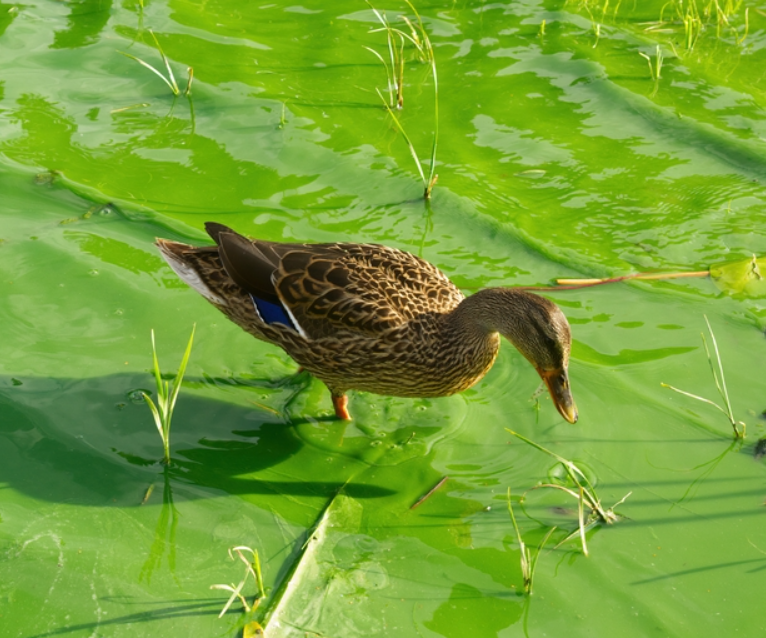
It’s one of the oldest existing lifeforms on the planet—blue-green algae. Treating bodies of water affected by “harmful algae blooms” or HABs, is an all-encompassing water treatment challenge, one that begins by understanding the opportunistic nature of these organisms and the constant nature of their threat to water quality, from pools to ponds to the world’s largest lakes.
By Eric Herman
Blue-green algae blooms have been in the news quite a lot this summer.
First, there was the controversy surrounding the Lincoln Memorial Reflecting Pool in Washington D.C. The troubled renovation not only suffered a severe failure of its new coating but also from a massive algal bloom when it was refilled. The pool had been plagued with algae problems since it was built over a century ago, while the latest outbreak became part of a national discussion and, indeed, an embittered argument; it was far from new.
The other source of attention has been in the form of the harmful algae blooms (HABs) that are impacting bodies of water worldwide. It’s become an annual cycle of poor water quality that has resulted in a variety of problems, from compromised tourism, fishing and all forms of water recreation. While municipalities and other government agencies have mobilized to try and combat the outbreaks with varying degrees of success, and oftentimes futility, the issue remains from and center in our collective aquatic experience.
And, of course, blue-green algae does invade swimming pools regularly.
With all of that in mind, here are some of the most fascinating facts about blue-green algae, more accurately known as cyanobacteria, one of the oldest, most resilient, and most influential groups of organisms on Earth.
Fascinating Algal Facts
- They are among the oldest living organisms on Earth.
Cyanobacteria first appeared approximately 3.5 billion years ago, making them one of the earliest known life forms. Fossils called stromatolites preserve evidence of their existence from the Archean Eon. (See the timeline below). - They are not algae at all.
Despite the common name “blue-green algae,” cyanobacteria are actually bacteria. Unlike true algae, they lack a nucleus and other membrane-bound organelles, placing them among Earth’s simplest life forms. - They transformed Earth’s atmosphere.
Through oxygen-producing photosynthesis, cyanobacteria gradually filled the atmosphere with oxygen during the Great Oxygenation Event about 2.4 billion years ago. Without them, complex plants, animals, and humans likely would never have evolved. - Every breath you take owes something to cyanobacteria.
Modern cyanobacteria continue to produce an estimated 20 to 30 percent of Earth’s oxygen, sharing that responsibility with marine algae and phytoplankton. - They invented oxygenic photosynthesis.
Cyanobacteria were the first organisms known to split water molecules using sunlight, releasing oxygen as a byproduct. This revolutionary biochemical process remains the foundation of nearly all life on Earth today. - Plants are their distant descendants.
More than a billion years ago, an ancestral cyanobacterium was engulfed by a primitive cell. Instead of being digested, it evolved into the chloroplast, the green energy-producing organelle found in every plant and alga today. - They thrive almost everywhere.
Cyanobacteria inhabit oceans, lakes, rivers, wetlands, deserts, glaciers, hot springs, cave walls, Antarctic ice, tropical rainforests, and even the surfaces of rocks and buildings. - Some species can survive extreme conditions.
Certain cyanobacteria tolerate temperatures approaching 160°F (70°C) in geothermal springs, while others survive freezing polar environments, intense ultraviolet radiation, and prolonged drought. - Many species can make their own fertilizer.
Specialized cells called heterocysts enable some cyanobacteria to convert atmospheric nitrogen into usable nutrients, enriching soils and aquatic ecosystems naturally. - They helped build ancient reefs.
Cyanobacteria formed layered structures called stromatolites, some of Earth’s oldest fossils. Living stromatolites still exist today in places such as Shark Bay, Australia, offering a glimpse into Earth’s distant past. - They remain one of Earth’s most abundant organisms.
Trillions upon trillions of cyanobacterial cells inhabit oceans and freshwater systems, forming an essential part of global food webs. - They are remarkably adaptable.
Over billions of years, cyanobacteria have survived asteroid impacts, supervolcanoes, global glaciations, shifting continents, mass extinctions, and dramatic changes in atmospheric chemistry. 
- Not all blooms are harmful.
Many cyanobacterial populations provide valuable ecosystem services and support aquatic food chains. Problems arise when environmental conditions allow certain species to multiply explosively. - Harmful algal blooms are increasing worldwide.
Nutrient pollution from fertilizers, livestock operations, wastewater, combined with warmer water temperatures and changing rainfall patterns, has contributed to more frequent and intense cyanobacterial blooms across the globe. - Some blooms produce dangerous toxins.
Species such as Microcystis, Dolichospermum, and Planktothrix can produce cyanotoxins that affect the liver, nervous system, or skin, posing risks to humans, pets, livestock, and wildlife. - A bloom can change an entire lake.
Dense cyanobacterial blooms block sunlight, reduce underwater plant growth, consume oxygen as they decompose, and can create “dead zones” where fish and aquatic invertebrates cannot survive. - Dogs are especially vulnerable.
Pets that drink or swim in water containing toxic blooms can become seriously ill within hours. Exposure has caused numerous animal fatalities worldwide. - They can regulate their position in the water.
Tiny gas-filled structures inside many cyanobacteria act like miniature flotation devices, allowing them to rise toward sunlight or sink into nutrient-rich water. - Some species glow with brilliant colors.
Their pigments include chlorophyll along with phycocyanin, which gives them their characteristic blue-green color, and phycoerythrin, which can create vivid red or purple hues. - They communicate chemically.
Cyanobacteria release signaling molecules that help coordinate colony behavior and respond collectively to environmental changes. - Scientists are studying them for future technologies.
Researchers are investigating cyanobacteria for applications ranging from biofuels and biodegradable plastics to carbon capture, pharmaceuticals, sustainable fertilizers, and even life-support systems for future space missions. - They are both creators and destroyers.
Cyanobacteria helped make Earth habitable by producing oxygen, yet under modern nutrient-rich conditions they can also create toxic blooms that threaten drinking water supplies, fisheries, recreation, and public health. - Their longevity comes from extraordinary simplicity.
Cyanobacteria reproduce rapidly, evolve quickly, exploit diverse habitats, switch metabolic strategies when conditions change, and possess remarkable genetic flexibility. These traits have allowed them to persist through nearly three-quarters of Earth’s history. - They remind us that success is measured in endurance.
Dinosaurs dominated Earth for roughly 165 million years. Humans have existed for about 300,000 years. Cyanobacteria have endured for 3.5 billion years, making them among the most successful organisms ever to evolve. - They embody one of nature’s greatest paradoxes.
The same organisms that oxygenated the atmosphere, made complex life possible, and continue to sustain Earth’s ecosystems can also become toxic nuisances when human activities overload waterways with nutrients. Their story is a reminder that even life’s oldest allies depend on ecological balance.
References
[] Schirrmeister, B. E., Gugger, M., & Donoghue, P. C. J. (2015) “Cyanobacteria and the Great Oxidation Event: Evidence from genes and fossils.” Palaeontology, 58(5), 769–785. DOI: 10.1111/pala.12178
[] Demoulin, C. F., Lara, Y. J., Lambin, E. F., et al. (2019) “Cyanobacteria evolution: Insight from the fossil record.” Free Radical Biology and Medicine, 140, 206–223.
DOI: 10.1016/j.freeradbiomed.2019.05.007
[] Bothe, H., Schmitz, O., Yates, M. G., & Newton, W. E. (2010) “Nitrogen Fixation and Hydrogen Metabolism in Cyanobacteria.” Microbiology and Molecular Biology Reviews, 74(4), 529–551.
[] Huisman, J., Codd, G. A., Paerl, H. W., Ibelings, B. W., Verspagen, J. M. H., & Visser, P. M. (2018) “Cyanobacterial blooms.” Nature Reviews Microbiology, 16, 471–483.
[] Schopf, J. W. (2014) “Geological evidence of oxygenic photosynthesis and the biotic response to the 2400–2200 Ma ‘Great Oxidation Event.’” Biochemistry (Moscow), 79(3), 165–177.DOI: 10.1134/S0006297914030018
Photos by Trieu Tuan | Shutterstock.