








Preventive Heater Maintenance
Most pool heaters don’t fail because they’re old. They fail because small problems are ignored until they become expensive ones. Here, Rocco Russo, senior trainer for Fluidra Pro Academy, takes a deep dive into how heater care saves money, protects homeowner investments and builds trust. Keeping a few technical detail and procedures in mind can offer a range of benefits.
By Rocco Russo
Over the years, I’ve seen homeowners spend thousands of dollars replacing heat exchangers, blowers, gas valves, and entire heaters, when a simple preventive maintenance program could have prevented those failures in the first place. I’ve also seen service companies lose money chasing recurring problems that could have been identified early through proper inspections and diagnostics.
I’ve always believed that preventive maintenance is one of the most valuable services a technician can provide. A well-maintained heater runs more efficiently, reliably, lasts longer, and operates more safely. Just as important, preventive maintenance helps identify dangerous conditions before they become emergencies.
When I teach heater service and diagnostics, I always begin with the same message: protecting the customer starts with protecting yourself.
Safety Comes First
The very top priority when dealing with heaters is personal safety, both yours and your customers’.
That starts with reading the manufacturer’s manual. Every model of heater is somewhat different, and every manual contains critical information regarding installation, operation, diagnostics, and safety requirements. I always encourage technicians to understand the hierarchy of manufacturer notices, from attention and caution to warnings, and to treat each one accordingly.
One of the most serious hazards we face is carbon monoxide. Incomplete combustion can produce carbon monoxide whether a heater is burning rich or lean. Something as simple as a spider web in an air intake or a mud dauber nest in a gas train can disrupt combustion enough to create a potentially harmful or even deadly situation.
For that reason, I recommend carbon monoxide detectors in adjacent living spaces whenever a heater is installed or replaced. It’s a small investment that provides significant protection for homeowners and their families.
Another important safety tool is the red tag. Some technicians view red tagging equipment as a negative experience, but I see it differently. Every red tag should come with a proposal. If equipment is unsafe, explain why it is out of compliance and provide a clear path toward correcting the problem.

Not every code issue requires shutting equipment down. Over time, technicians develop a sense for what constitutes an immediate hazard and what can simply be documented for future correction. If the condition presents an immediate danger to people or property, that’s when I break out the red tag.
Understanding Code Compliance
One of the most expensive mistakes technicians make is assuming that an existing installation automatically meets today’s requirements.
Codes change, and every replacement installation must comply with current rules. I often use exhaust clearances as an example. Years ago, certain distances from doors and windows were acceptable, but no longer meet current code. When a new heater goes in, today’s standards apply. That’s one more reason why reading the manual is incredibly important. Manufacturers update their requirements as codes evolve, and the manual reflects those changes immediately.
The same principle applies to pressure relief valves. Depending on local code requirements and system design, relief valves may be required to protect the heater from excessive pressure. Whenever I quoted a heater replacement, I’d discuss these safety components along with carbon monoxide detectors. My goal is to show customers that I’m looking out for their long-term safety, not simply swapping equipment.
The Program That Builds Business
For years, I offered a simple guarantee. If I performed a complete preventive maintenance service on a heater, and that heater failed within 90 days, I returned at no labor charge. The reason I could make that promise was simple: PM works.
A proper PM visit starts with the thermal regulator valve. In my opinion, that’s job one.
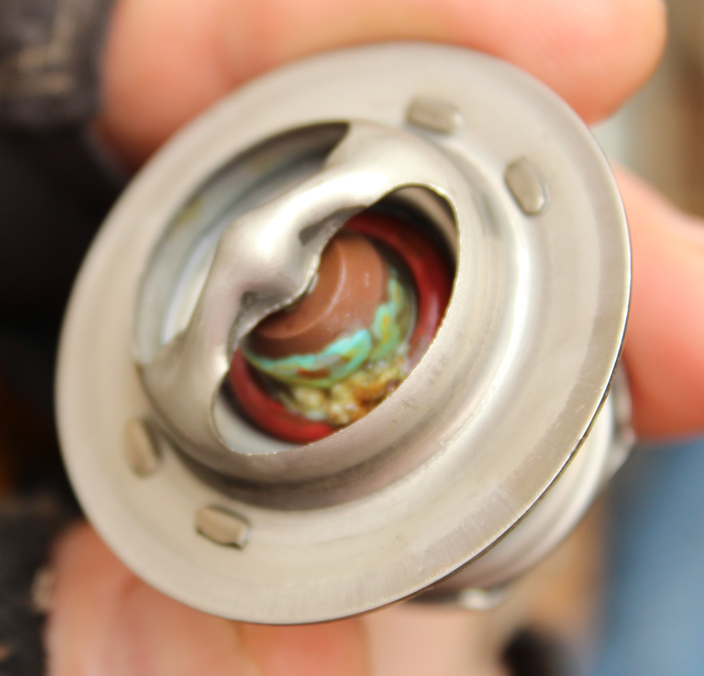
Every residential gas heater has some version of this component. Its purpose is to regulate water flow through the heat exchanger while the combustion chamber warms up. When it fails, condensation and temperature imbalances can begin damaging the exchanger.
In year-round markets such as Florida, Texas, and Southern California, I recommend replacing thermal regulators annually. In seasonal climates, technicians may be able to extend that interval somewhat, but ignoring the component for too long often leads to scale formation and premature exchanger failure.
Understanding Flow Rates
One of the most misunderstood aspects of heater operation is water flow. Many technicians know that heaters have acceptable operating ranges, but optimal flow rates depend heavily on water temperature and application.
A swimming pool at 55 degrees may perform perfectly at a relatively modest flow rate. A hot tub operating above 100 degrees requires substantially more water movement to properly cool the combustion chamber and prevent scaling.
As a general guideline, I like to see approximately 65 to 70 gallons per minute for pools and closer to 90 gallons per minute for spas. The objective is always the same: provide enough flow to transfer heat effectively while preventing excessive temperatures inside the exchanger.
Diagnosing Gas and Ignition Systems
Gas pressure testing requires more than a single measurement.
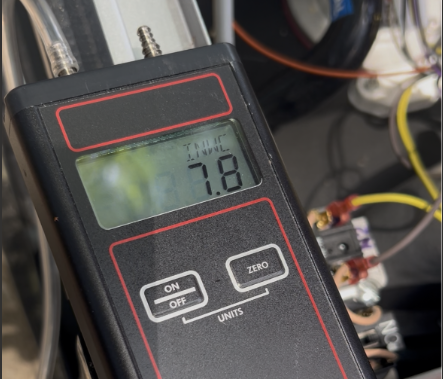
I always check three conditions: static pressure before firing, operating pressure while firing, and lock-up pressure after shutdown.
Static pressure tells me what the regulator is providing. Operating pressure shows whether the gas delivery system can provide the required volume. Lock-up pressure reveals whether the regulator is functioning properly after shutdown.
A simple memory aid is “7-11”: seven inches of water column for natural gas and eleven inches for propane are optimal operating pressures. If lock-up pressure continues to creep upward instead of stabilizing, it’s often a sign that the regulator is failing and should be replaced.
Igniters deserve equal attention. Before firing the heater, I check resistance while the igniter is cold. Once energized, temperatures can reach several thousand degrees, making resistance measurements unreliable.

I then measure amperage during igniter heat-up. If the igniter is drawing close to 4.5 amps or higher, replacement is often warranted even if it still functions. These components take a beating and are among the most frequently replaced parts in modern heaters.
Following the Heat
One of the most valuable diagnostic procedures involves measuring heat transfer and exhaust temperature.
If exhaust temperatures are excessively high, heat is not being transferred efficiently into the water. That can indicate combustion issues, soot, scale accumulation, restricted airflow, or water flow problems.
One of my favorite field techniques is removing the blower assembly, sliding the burner aside, and using a leaf blower to clear the combustion chamber. The amount of soot and debris that comes out can be astonishing.
After cleaning, I’ve seen exhaust temperatures drop by 65 to 80 degrees.
If temperatures remain above 400 degrees after blowing out debris, more extensive cleaning may be required using wire brushes and compressed air. Water should never be used to clean a combustion chamber because it can damage refractory insulation components.
The Tools That Matter
Every technician develops favorite tools, but my preventive maintenance kit remains fairly consistent.
I carry pipe wrenches, drivers, slip-joint pliers, a gas sniffer, leak detection solution, a manometer, a clamp amp meter, and remote temperature probes.
The amp meter is especially valuable because it allows me to predict failures before they happen. A blower motor running near its maximum rated amperage and operating at elevated temperatures is telling you that its remaining service life is limited.
When checking for gas leaks, I still trust soap and water applied with a paintbrush. As an old friend used to say, “No bubbles, no troubles.”
Electronic detectors have their place, but batteries fail and sensors age. Soap bubbles remain one of the most reliable leak detection methods available.
And no, nobody should ever use a lighter to check for gas leaks!
I’ve often joked that there are two types of gas-heater technicians: those who have been burned and those who will be burned.
Look Before Replacing Parts
One of the best diagnostic tools available today is the borescope.
Through an igniter opening or service port, technicians can inspect burner surfaces and heat exchanger passages without extensive disassembly. Even a smartphone camera can provide valuable visibility when access allows.
I once encountered a heater where multiple expensive components had already been replaced, including the gas valve, blower, and igniter. The actual problem turned out to be debris clogging burner ports.
Thousands of dollars had been spent because nobody took the time to look inside first.
Good diagnostics always beat guesswork.
Professionalism Drives Profitability
Throughout my career, I’ve found that technical excellence and profitability go hand in hand.
Customers are willing to pay more when they see professionalism, thorough documentation, code compliance expertise, and a commitment to safety. That’s why I encourage technicians to present options. Give customers good, better, and best solutions. Not everyone chooses the premium package, but offering choices consistently leads to better customer satisfaction and stronger sales.

I also believe presentation matters. Before leaving a job site, I wipe down the heater cabinet. A clean heater demonstrates that work was performed and gives customers visible evidence of the value they received. A spotless heater creates confidence. A dirty one raises questions.
Another recommendation I make, even though I’ve never seen it specifically written in a manual, is maintaining at least five feet of separation between gas heaters and heat pumps whenever possible. Heat pump fans can influence combustion air, leading to sooting, reduced efficiency, and shortened equipment life.
Building Expertise
The best technicians never stop learning.
One of the most encouraging developments I’ve seen is the growing collaboration between manufacturers and educational organizations such as Watershape University. Hands-on training programs help technicians gain practical experience while earning credit toward professional certifications.
My advice to anyone looking to improve their heater diagnostics is simple: spend time studying heaters that are operating correctly.
Measure gas pressure. Check amperage. Record temperatures. Observe ignition sequences with a stopwatch. Learn what normal looks like. Once you understand how a healthy heater behaves, diagnosing a malfunction becomes dramatically easier.
At the end of the day, my goal has never been to simply fix broken heaters. The real objective is preventing breakdowns before they happen, protecting homeowners from safety hazards, and helping service companies build profitable businesses through genuine expertise.
When you work on a gas heater, you’re not just moving a box from point A to point B. You’re dealing with gas, water, and electricity all at once. Done properly, that’s an opportunity to provide real value, save customers money, and build trust that lasts for years. When you deliver the perfect pool experience, they’ll remain customers for life.
Rocco Russo is a senior trainer with Fluidra Pro Academy.