


A Journey Through the Paris Sewers
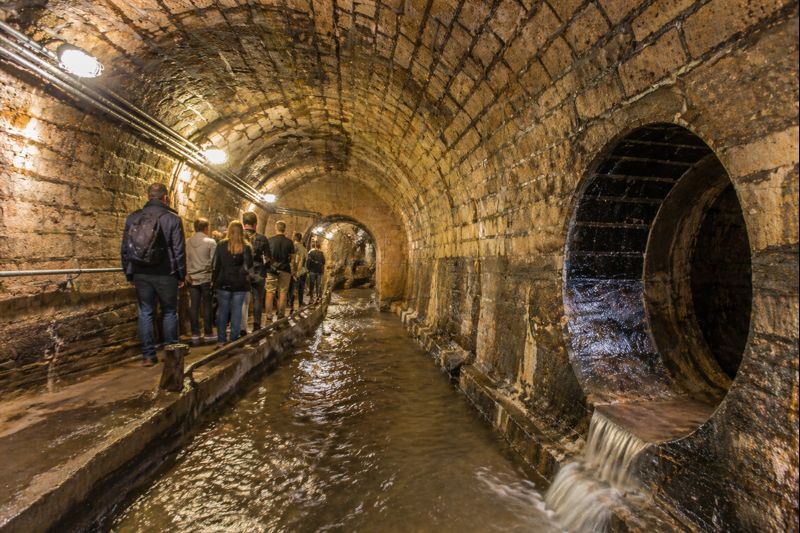
There is no place quite the like the sewers of Paris. Beginning with the very notion that a sewer could be the subject of wonder and fascination is counterintuitive, but when you take the trip below the streets, what watershaping mastery is both surprising and inspiring.
By Eric Herman
It was many years ago, when on my first trip to France, I learned that in Paris, even the sewers are works of art. I certainly never expected to fall in love with a sewer. But then again, I had never walked beneath the streets of the City of Light.
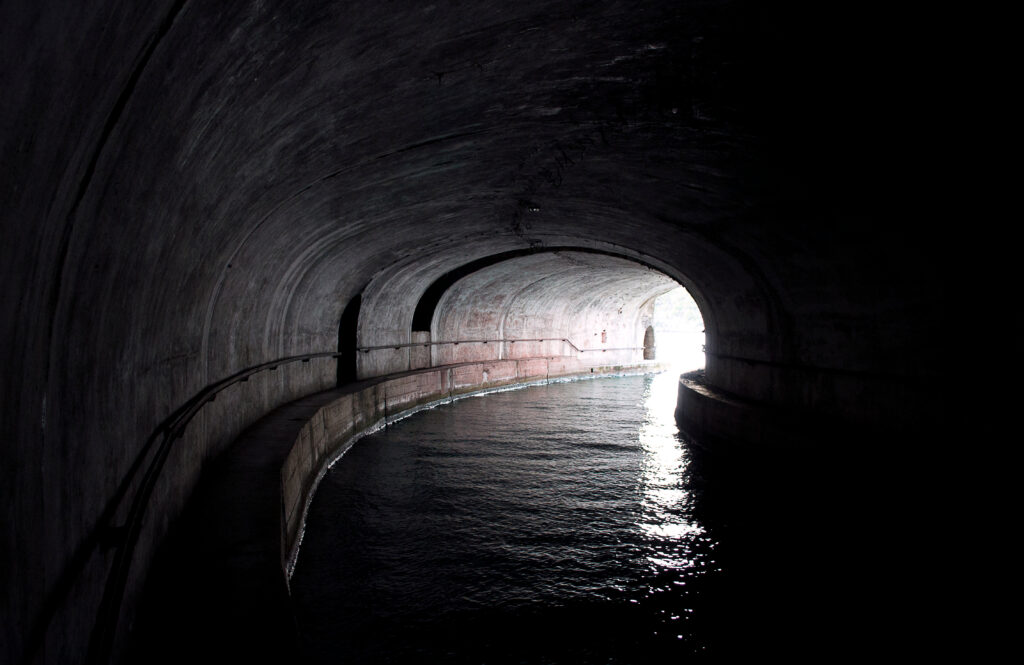
Descending into the historic subterranean realm, I felt the cool breath of stone and water wrap around me. The air was damp, heavy with a mix of mineral scent and history, and the sound of trickling water follows you everywhere, echoing through vaulted tunnels.
It is a place of surprising and mysterious beauty, remarkable engineering and hidden history. The Paris Sewers, les égouts, are not some grim oubliettes of waste and shadow. Rather they are very much an underground cathedral of ingenuity, a labyrinth of stone and iron that for centuries helped make Paris one of the world’s most livable and modern cities. The sewers are a cultural landmark, and a reminder that civilization flows as much beneath the surface as it does above.
Into the Deep
As I walk the passageways, I’m struck first by their sheer scale. They are broad, arched tunnels, high enough to walk upright, lined with massive stones and bricks laid down with precision. The water flows steadily through carefully graded channels, the geometry exact and efficient. Some of the larger chambers are astonishing, with grand vaulted ceilings that could easily be mistaken for medieval crypts.
It was Baron Haussmann and engineer Eugène Belgrand in the 19th century who envisioned this vast network, marrying elegance to function. They expanded upon older medieval drains, creating a modern sewer system that would transform public health. Cholera and typhoid had ravaged Paris, but the sewers, along with clean water distribution, turned the tide. Knowing that little bit of history, what you feel down here, walking in the half-light is not the sense of a triumph, an achievement that saved lives and defined a new standard for cities around the world.
And make no mistake: the Paris sewers are a point of pride. The French are not shy about celebrating them. Since 1867, tourists have been invited down to see them firsthand. Even Victor Hugo, in Les Misérables, gave the sewers a starring role, describing them as the “conscience of the city.” I thought of that as I listened to my own footsteps on the damp floor, echoing like a drumbeat of history.
Below the Boulevards
Visitors to Paris often come for the grand boulevards, the luminous monuments, the charming cafés, and the world-class museums. But just beneath the cobblestones lies another world, a vast, hidden city of water, brick, and stone that has shaped Parisian life for centuries.
There, in vaulted tunnels lit with subdued lamps, one finds not just a story of sanitation, but of ingenuity, resilience, and pride.
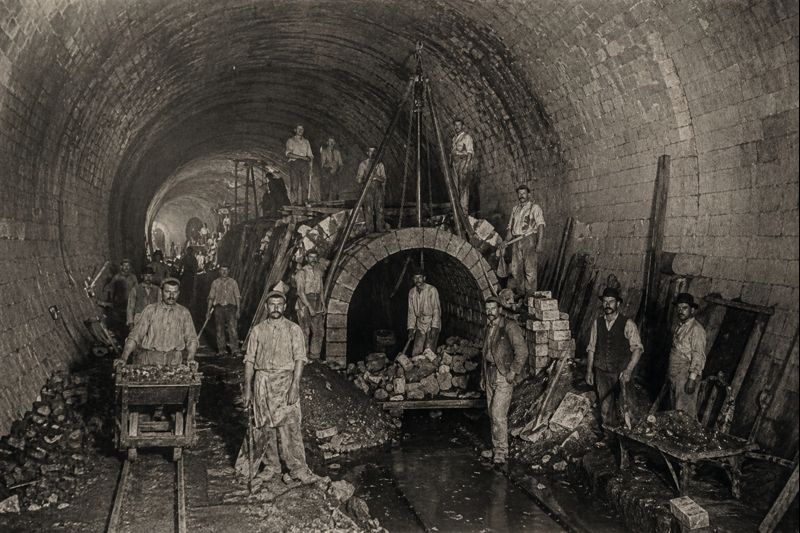
The history of Paris’s sewers stretches back to the 14th century when open drains ran along the streets, carrying waste away but also spreading disease. By the 19th century, the situation had become untenable.
Solving the problem required unprecedented innovation and the resulting system was monumental. Miles of vaulted tunnels, constructed of stone, brick, and later concrete, carried wastewater safely away from the city and provided channels for potable water and stormwater management. For the first time, clean water and sewage were separated on a grand scale, a revolutionary step in public health.
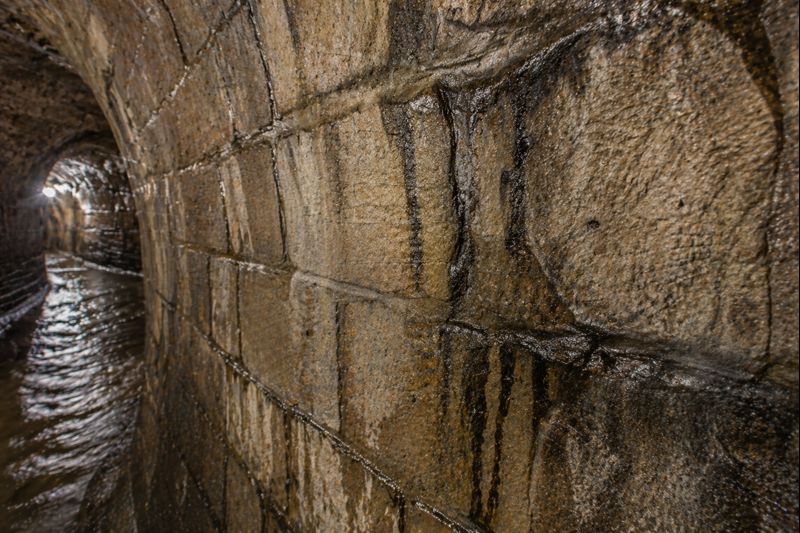
The materials themselves tell a story. Stone, brick, and later, reinforced concrete, all chosen for endurance, all weathered by time and water. Iron ladders climb up to street level, heavy grates filter debris, and the whole place hums with practical design. And yet, there’s an undeniable poetry here.
And they have their fair share of mystery, too. Tales of secret meetings, wartime shelters, even hidden treasures circulate in the Parisian imagination. Standing in a dimly lit junction, with water rushing at my feet, I could almost hear whispers from the past. And there’s humor as well: in one gallery, a display shows off the machines and boats that workers used to clean the sewers, part steampunk contraptions, part surreal theater.
An Underground Network
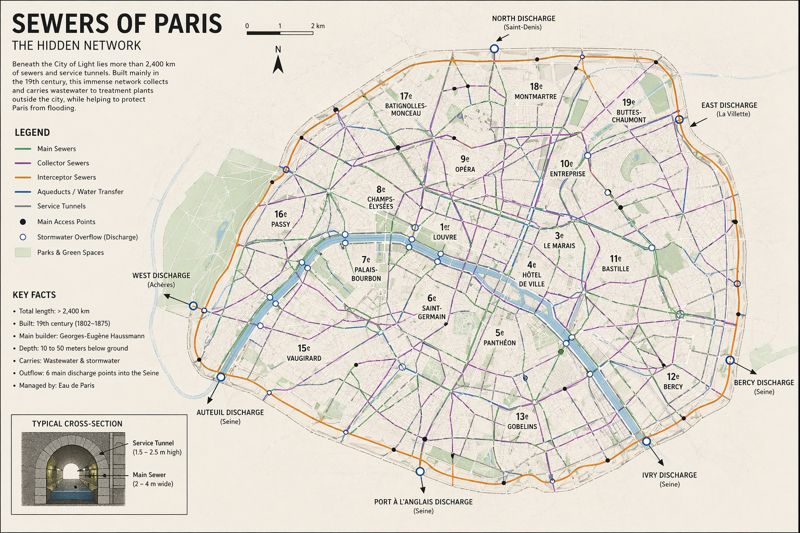
Today, Paris boasts more than 1,300 miles of sewers, nearly mirroring the street network above. Some passages are wide enough for boats (historically used by workers to navigate the system), while others are narrow corridors lined with pipes, ladders, and sluice gates. The tunnels are marked with street signs, mirroring the city above, creating an uncanny parallel metropolis below the metropolis.
The technical design is as elegant as it is practical. Flowing channels are graded with precision created gentle gravity flow throughout the system. Vaults are reinforced to withstand time and tides, and materials have evolved from cut stone to reinforced concrete. Maintenance is still a point of pride as teams of sewer workers, affectionately known as égoutiers, tend the system with dedication, wearing chest-high waders and carrying on a tradition that is both arduous and honorable.
Few cities in the world hold their sewers in such esteem. In Paris, they are not merely infrastructure; they are woven into the city’s cultural fabric. Tourists since the 19th century have been invited down below, guided through tunnels that reveal both the guts and glory of the city.
They embody the mystery of Paris, an underground as layered and storied as the streets above.
Historic Innovations
From a purely watershaping perspective, the technical story behind the sewers is as fascinating, if not more so, than the historic context.
The system is a highly sophisticated urban water-management machine that evolved from medieval drainage ditches into a modern environmental-control network integrating hydrology, microbiology, wastewater chemistry, stormwater engineering, and automated sanitation technology.
The history of Parisian sewer hydrology is fundamentally the story of how a city learned to manage water, waste, disease, and flooding simultaneously.
In medieval Paris, wastewater disposal was primitive and localized. Human waste, slaughterhouse refuse, and household wastewater were dumped into streets or cesspits, eventually draining into the Seine River. Rainwater runoff mixed freely with organic waste, creating stagnant conditions ideal for bacterial growth and waterborne disease. Hydrologically, the city functioned as an uncontrolled watershed. Stormwater carried contaminants downhill through narrow streets toward the river, while groundwater infiltration often contaminated drinking wells.
The first major attempt at organized sewerage appeared under King Philippe Auguste in the late 12th century, when stone-lined drainage channels were constructed beneath major roads. These early conduits relied entirely on gravity flow. Paris sits in a relatively shallow basin, and engineers exploited subtle gradients to move wastewater toward the Seine. The slopes were often only a few millimeters per meter, requiring careful masonry alignment to prevent stagnation.
By the 19th century, Paris faced repeated cholera epidemics driven by fecal contamination of water supplies. Belgrand revolutionized sewer hydrology using several key principles. First, he dramatically expanded the sewer network into a hierarchical hydraulic system. Large interceptor tunnels collected flow from smaller branch sewers, much like tributaries feeding a river. The network became a controlled artificial watershed beneath the city.
Second, the tunnels were deliberately oversized. Unlike earlier sewers designed only for dry-weather waste flow, Belgrand’s system accounted for storm surges. Paris experiences episodic heavy rainfall events capable of rapidly increasing runoff volumes from impervious surfaces such as stone streets and rooftops. The larger conduits acted as temporary detention basins, buffering peak flows and reducing flood risk.
Third, the system separated functions spatially, though not fully by modern standards. Drinking water aqueducts and sewer tunnels occupied distinct underground corridors. This reduced cross-contamination and represented an early form of sanitary zoning.
The hydrology of the classic Paris sewer system was based on combined sewers, meaning stormwater and sanitary waste traveled together through the same conduits. Combined systems have both advantages and disadvantages. During dry weather, wastewater concentrations remain relatively high, helping maintain self-cleansing velocities inside pipes. Engineers generally aim for velocities above approximately 0.6 meters per second to prevent sediment deposition. During rainfall, however, flow volumes can increase dramatically, creating combined sewer overflows, or CSOs, in which diluted but untreated sewage discharges into rivers.
Paris historically experienced this problem acutely. Heavy storms could overwhelm treatment capacity and force excess water directly into the Seine. Hydrologically, this reflects a mismatch between instantaneous runoff generation and downstream conveyance or treatment capacity.
Modern Parisian sewer engineering addresses this using several interconnected technologies.
One major strategy involves underground storage reservoirs. Massive retention basins temporarily store stormwater surges during rain events. After storms subside, the stored water is gradually released for treatment. These systems function as hydraulic equalization chambers, smoothing peak-flow hydrographs and preventing treatment plant overload.
Another strategy involves real-time hydraulic monitoring. Modern sensors distributed throughout the network continuously measure flow rates, water depth, pressure, turbidity, and pollutant concentrations. Computerized supervisory control systems dynamically redirect flows using automated gates and pumping stations. In effect, the sewer system now behaves like a managed circulatory network rather than a passive drainage structure.
The sanitation technology itself has also evolved enormously.
In the 19th century, Parisian sanitation relied largely on conveyance rather than treatment. Wastewater was moved away from populated areas and discharged downstream or spread onto agricultural fields outside the city. This practice, known as sewage farming, exploited natural soil filtration and plant nutrient uptake. Organic matter decomposed aerobically in soils, while crops absorbed nitrogen and phosphorus compounds.
Although surprisingly effective by the standards of the time, sewage farming could not adequately remove pathogens, heavy metals, pharmaceuticals, or industrial chemicals.
Modern wastewater treatment in Paris now involves advanced multistage processing at facilities such as the Seine Aval treatment plant near Achères, one of Europe’s largest wastewater treatment complexes.
The treatment process begins with preliminary screening. Mechanized bar screens remove large debris such as plastics, rags, and solid waste. Grit chambers then slow water velocity, allowing dense mineral particles like sand and gravel to settle by gravity.
Primary treatment follows. Wastewater enters large sedimentation tanks where suspended organic solids settle into sludge. Oils and fats float to the surface and are skimmed away. This stage significantly reduces biochemical oxygen demand, or BOD, which measures how much dissolved oxygen microorganisms will consume while decomposing organic matter.
Clean Chemistry
Secondary treatment introduces biological purification. Paris now relies heavily on activated sludge systems. In these reactors, wastewater is aerated intensely to support aerobic bacteria and protozoa that metabolize dissolved organic pollutants.
The microbiology is extraordinarily complex. Diverse bacterial communities oxidize carbon compounds into carbon dioxide and water while converting ammonia into nitrate through nitrification. Additional denitrifying bacteria then reduce nitrate into nitrogen gas under low-oxygen conditions, preventing excessive nutrient release into the Seine.
These microbial transformations are essential because ammonia toxicity can severely damage aquatic ecosystems.
Modern Paris treatment facilities also incorporate phosphorus removal systems. Excess phosphorus stimulates eutrophication, causing algal blooms that deplete oxygen in rivers. Chemical precipitation using iron or aluminum salts converts dissolved phosphates into insoluble compounds that can be removed as sludge.
Disinfection technology has evolved as well. Historically, the Seine downstream of Paris carried dangerously high pathogen loads, including fecal coliform bacteria. Modern systems increasingly employ ultraviolet disinfection and ozonation in addition to chlorination. UV radiation damages microbial DNA, preventing reproduction without introducing residual chlorine compounds into ecosystems.
Rainfall & Runoff
Hydraulically, modern Parisian sewer management also confronts climate change. More intense rainfall events create flashier urban runoff hydrographs, increasing flood risk and CSO frequency. Engineers now incorporate green infrastructure into the hydrologic equation. Permeable pavements, vegetated roofs, infiltration basins, and urban wetlands reduce runoff velocity and increase groundwater recharge.
This represents a conceptual shift from rapid drainage toward distributed hydrologic moderation. Instead of treating rainwater as waste to be expelled immediately, modern urban hydrology attempts to slow, infiltrate, and biologically process stormwater closer to where it falls.
Another modern concern involves micropollutants. Pharmaceuticals, endocrine disruptors, microplastics, and industrial chemicals pass through traditional treatment systems with varying efficiency. Paris has invested heavily in advanced oxidation technologies and membrane filtration research to address these contaminants.
Even sewer maintenance itself has become technologically sophisticated. Historically, sewer workers manually removed sediment accumulation using shovels and flushing carts. Today, robotic inspection systems equipped with cameras and sonar map tunnel conditions continuously. High-pressure flushing vehicles remove sediment while minimizing worker exposure to toxic gases such as hydrogen sulfide and methane.
Hydrogen sulfide formation remains a persistent biochemical challenge in sewer systems worldwide. Under anaerobic conditions, sulfate-reducing bacteria generate H₂S gas. This gas is both toxic and corrosive, reacting with moisture to form sulfuric acid that attacks concrete infrastructure. Modern Paris sewers combat this using forced ventilation, oxygenation systems, corrosion-resistant materials, and chemical dosing.
Today, the Paris sewer network extends roughly 2,600 kilometers, functioning as a hidden hydraulic city beneath the visible one. It carries wastewater, stormwater, and enormous historical significance simultaneously. What began as a desperate attempt to remove filth evolved into a highly integrated environmental-engineering system balancing hydrology, microbiology, chemistry, flood control, public health, and ecological restoration.
The Paris sewers are therefore far more than tunnels carrying waste. They are a living demonstration of how urban civilization depends on invisible systems of water movement and purification. Beneath the boulevards and monuments lies an engineered river network, continuously cleaning, circulating, buffering, and protecting one of the world’s great cities.
Why They Still Matter
It’s easy to forget, amid the glamour of the Champs-Élysées or the Seine, that the health and beauty of Paris depend on what lies beneath. The sewers remain essential for public health, stormwater management, and environmental protection. They continue to evolve, integrating modern treatment technologies, monitoring systems, and ecological safeguards. In an era of climate change and urban flooding, the lessons of Paris’s sewers, scale, foresight, and durability, are more relevant than ever.
Today, the Sewer Museum welcomes thousands of visitors each year, curious to see what most cities prefer to hide. It’s not only a fascinating look at engineering; it’s a perspective shift. Walking through those tunnels, you realize that a city’s greatness is not only in its monuments but in its unseen systems, the work that sustains life, protects health, and ensures beauty above can flourish.
Tourists like me still come, drawn by curiosity, and leave astonished. You enter expecting filth, and emerge realizing you’ve seen something profound. Few infrastructures are so alive with history and so vital in the present. Paris still depends on this system, still maintains and expands it, still treats it with the reverence it deserves.
As I climbed back into the daylight, blinking at the sudden brightness of the Seine glittering nearby, I felt a new kind of admiration for Paris. Above ground, the city dazzles with its boulevards and cathedrals. But underground, in its sewers, it reveals its resilience, ingenuity, and humility. Who knew that beneath the cobblestones and cafés, there lay a world so wonderful, so necessary, and so strangely beautiful?
References: Ravlic, Anita.“Paris Sewers: A 19th Century Heritage to Be Adapted to the Challenges of the 21st Century.” Blue Papers (2026). Barles, Sabine, and André Guillerme. “Paris: A History of Water, Sewers, and Urban Development.” In A History of Water, Series 3, Vol. 1: From Jericho to Cities in the Seas: A History of Urbanization and Water Systems, edited by Terje Tvedt and Terje Oestigaard, pp. 384–409. London: I.B. Tauris, 2014. Kesztenbaum, Lionel, and Jean-Laurent Rosenthal. “Sewers’ Diffusion and the Decline of Mortality: The Case of Paris, 1880–1914.” Journal of Urban Economics 98 (2017): 174–186. Reid, Donald. Paris Sewers and Sewermen: Realities and Representations. Cambridge, MA: Harvard University Press, 1991. Bouttier, Ronan, and Nicolas Courtin. Un panorama historique illustré des égouts parisiens aux Archives de Paris.” In Situ 51 (2023).
Opening photo by Eric Herman; historic photo, googleapis.com; map of Paris sewers, Pintrest; Wall photo by Jim Wearne | Shutterstock; Last photo by Nela Kovac | Shutterstock.