


spillway

As the process of installing this beautiful little pond moves toward its conclusion, we find as always that we have lots of smallish details to consider - including the important task of creating a great look with the waterfall's spillway. This step may not take the strength or persistence or grand vision of some of the project phases covered to date in this video series, but I can assure you it takes both care and finesse - especially

Of all the design innovations that have spread through the general watershaping community in the past 20 years or so, I can’t think of any that has captured consumer imaginations as dramatically as have vanishing-edge designs. They rose from minimal presence in the late 1980s to become the most recognizable and popular of all

As a rule, those of us who build watershapes meant for purposes other than swimming or hydrotherapy tend to pursue one path or another: Either we make our ponds, streams and waterfalls look as natural as we can manage, or we establish them to reveal the hand of man either partly or completely. In that either/or context, successful design depends at least in part on being perfectly clear with ourselves about what we are trying to achieve. In assessing ponds of these opposing forms, it's my personal practice to look at both natural ponds and formal ponds (or, more accurately, architectural ponds) as being right on par with one another with respect to their potential for beauty. Indeed, architectural ponds can be incredibly appealing when done up in such a way that
As a rule, those of us who build watershapes meant for purposes other than swimming or hydrotherapy tend to pursue one path or another: Either we make our ponds, streams and waterfalls look as natural as we can manage, or we establish them to reveal the hand of man either partly or completely. In that either/or context, successful design depends at least in part on being perfectly clear with ourselves about what we are trying to achieve. In assessing ponds of these opposing forms, it's my personal practice to look at both natural ponds and formal ponds (or, more accurately, architectural ponds) as being right on par with one another with respect to their potential for beauty. Indeed, architectural ponds can be incredibly appealing when done up in such a way that
As a rule, those of us who build watershapes meant for purposes other than swimming or hydrotherapy tend to pursue one path or another: Either we make our ponds, streams and waterfalls look as natural as we can manage, or we establish them to reveal the hand of man either partly or completely. In that either/or context, successful design depends at least in part on being perfectly clear with ourselves about what we are trying to achieve. In assessing ponds of these opposing forms, it's my personal practice to look at both natural ponds and formal ponds (or, more accurately, architectural ponds) as being right on par with one another with respect to their potential for beauty. Indeed, architectural ponds can be incredibly appealing when done up in such a way that

One of the things I love about working in the southwest is the way the openness and rugged, sculptural appearance of the natural landscape opens the door to those who want to make bold architectural statements in concrete, stone, steel and glass. Even the plants here have an overtly sculpted quality. I appreciate this all the more by virtue of having worked in more tradition-bound places: Here in the southwest, I feel free to use a strong, contemporary design vocabulary in forging unique connections between built spaces and their dramatic surroundings. Although I'm perfectly comfortable working in those traditional styles, I'll admit to being heavily influenced by the masters of Modernism - particularly Frank Lloyd Wright and the German-born American architect Ludwig Mies van der Rohe - and love the way those amazing mid-20th-century designers used clear, sculptural geometries to direct the eye and define intricate spatial relationships. The project depicted here is a direct channeling of their influence, aided and abetted by
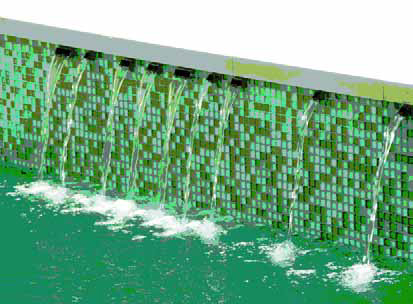
Elegance, romance, subtlety, tranquility: All these words speak to a potential of watershaping that is realized far too infrequently. If ever there were a common detail that typifies these missed opportunities, I'd have to give the prize to the standard waterfall/waterwall effects seen on too many pools and other watershapes these days. I can think of nothing less compelling than the typical sheet of water spilling down the face of a wall or in front of some other structure on its way into a pool or spa. This look is not only overused, but
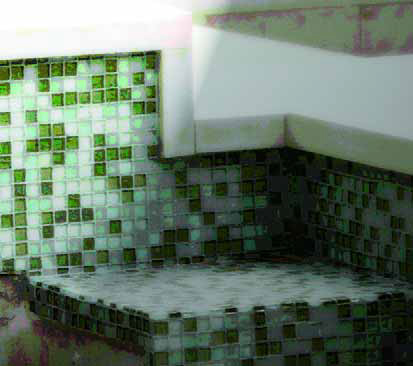
Many of the projects I tackle are largely about beauty and elegance and striking just the right balances between my watershaping and the setting, the architecture of the home and the character of my clients. In the case of the project depicted here, however, a couple of other considerations jumped into the mix - including impulses for fun and excitement as well as an overriding need to raise the visual energy level to align with the clients' personalities and a glorious setting. The result is an exquisitely adorned watershape that stands as one of the purest expressions of whimsy and unbridled joy I've ever produced. Truly, it all flowed from the clients and the setting. The clients are quite educated, well-traveled and sophisticated and had both the resources and the desire to do something special. Moreover, they're about as nice a couple as you could ever hope to meet and had refined tastes to match. As for the setting, we're talking beauty in the extreme: The home is a modern masterpiece perched atop a bluff in Malibu, Calif., with 180-degree ocean views and spectacular distant vistas. The only clinker on the property was the existing pool and the surrounding decks - an aggressively plain, kidney-shaped drag surrounded by equally boring decks. It was time for