


lighting design

For more than 10 years now, outdoor rooms have been growing steadily in both popularity and complexity. That’s great, because it enables designers – architects, landscape architects, landscape designers and pool builders alike – to bring interiors outside and provide living spaces where activities previously associated strictly with indoor spaces can move comfortably into the great outdoors. It’s a fantastic way to expand living areas and create useful spaces while also adding entirely new types of experiences to the lives of homeowners. Among this trend’s many implications is that it has challenged landscape lighting designers to think in all-new ways about how we light exterior spaces. For starters, we need to be aware that most homeowners will enjoy these spaces exclusively after dark – and also be conscious of the fact that these environments require much more complicated lighting schemes than classic suburban patios ever did. The differences are so profound that I believe lighting designers need to talk to clients in new ways that

In the landscape lighting business, we often hear complaints about glare and get lots of questions about how to bring it under control. In some cases, it’s a minor annoyance, but in others, some clients are so sensitive to the discomfort it can produce that it ruins entire lighting designs for them. So what exactly is “glare”? I define it as light transmitted directly from a source into an onlooker’s eyes (either directly or indirectly) in such a way that it’s a nuisance. Beyond the squinting

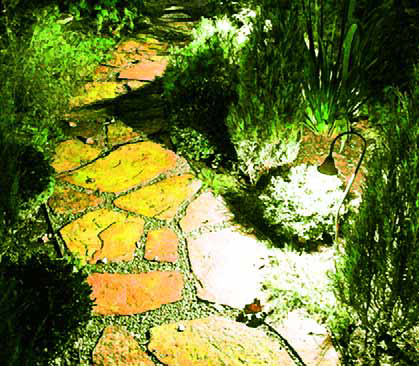
It's not an uncommon goal: Nearly all of the homeowners I speak with about lighting designs want to be able to move safely and comfortably around their properties at night. Perhaps more important, they want guests and others unfamiliar with those spaces to be able to do the same without anyone being concerned about suffering an injury as a result of a misstep brought on by darkness or glare. The interesting this is, some of my clients need convincing when it comes to path or step lighting: Even if they see

As I see it, successful landscape lighting is a two-part process: First, the designer applies aesthetic principles that create the art, then he or she supports that artistic vision with scientific and technological savvy. One without the other doesn’t work: You can’t effectively practice the art until you’ve mastered the science. In my 17 years as a lighting designer, I’ve encountered lots of professionals who have the artistic part of the equation down pat but fall well short when it comes to working with electricity. The plain fact is, you can use the best fixtures in the world and understand the aesthetic issues like the back of your hand, but if you can’t consistently deliver power to those fixtures at correct, reliable voltages, the overall system will not perform properly and has the potential to become a maintenance nightmare. There’s no way a single article can bring anyone up to speed with all of the issues involved in the science lighting. Instead, my intention here is to introduce watershapers to a basic, commonsense approach to laying out low-voltage, halogen lighting systems, the goal being to enable you to converse intelligently and persuasively with lighting designers in the interest of helping
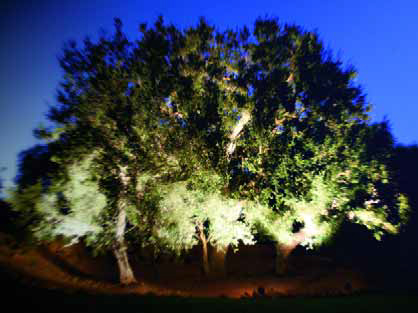
Although the eye is commonly drawn to structures and other architecture elements found in any given exterior environment, very often it is trees that serve as visual anchors in modern landscapes. Indeed, they tend to be the largest objects on most properties and will often become focal points even in settings in which they might have started out in supporting roles. This dominance or even potential for dominance is why, as a lighting designer, I believe that trees should always receive
Those of us who are designers and builders of full-scale outdoor environments (you know who you are) face a distinct challenge: In our work for our clients, we are expected to provide the outline and details for a huge range of project elements, from watershapes and patios to plantings and walkways and more. That list, at least so far as clients are concerned, also includes appropriate lighting, but that is not always something on which we focus. Indeed, lighting design is seen as a specialty even by those who tackle almost every other project feature - and there's no problem with that unless
Those of us who are designers and builders of full-scale outdoor environments (you know who you are) face a distinct challenge: In our work for our clients, we are expected to provide the outline and details for a huge range of project elements, from watershapes and patios to plantings and walkways and more. That list, at least so far as clients are concerned, also includes appropriate lighting, but that is not always something on which we focus. Indeed, lighting design is seen as a specialty even by those who tackle almost every other project feature - and there's no problem with that unless

When we work in public settings, the basic demand on lighting designers is for straightforward fixture layouts capable of providing enduring effects and requiring minimal ongoing attention. That doesn't sound particularly exciting - and it's not, unless the lighting designer uses it as a baseline and reaches above and beyond.Parks, plazas, resorts and historical sites (among many others) are all spaces that really should come alive at night, but their lighting designs often run counter to that vitality by being so utilitarian that they spark boredom rather than energy. It's easy to understand why this happens: Because such spaces play host to high levels of traffic and often multiple uses, they demand lighting treatments that
When we work in public settings, the basic demand on lighting designers is for straightforward fixture layouts capable of providing enduring effects and requiring minimal ongoing attention. That doesn't sound particularly exciting - and it's not, unless the lighting designer uses it as a baseline and reaches above and beyond.Parks, plazas, resorts and historical sites (among many others) are all spaces that really should come alive at night, but their lighting designs often run counter to that vitality by being so utilitarian that they spark boredom rather than energy. It's easy to understand why this happens: Because such spaces play host to high levels of traffic and often multiple uses, they demand lighting treatments that
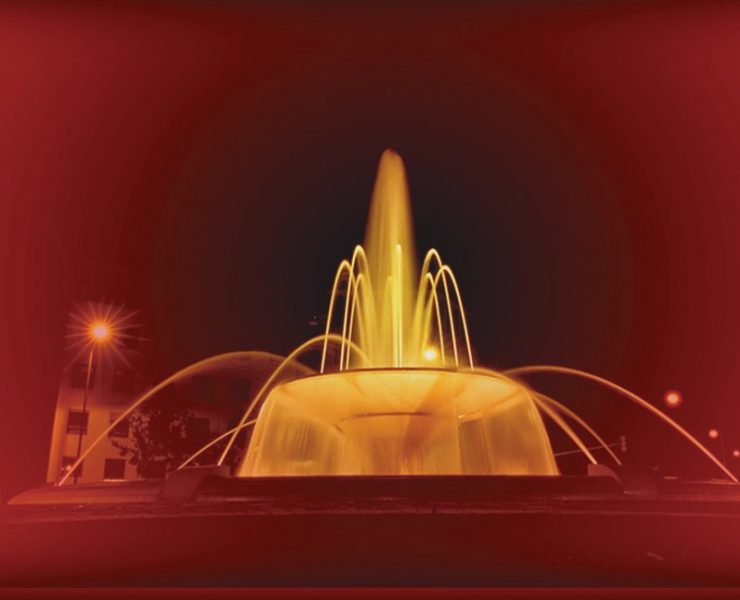
It's a simple notion: When designing illumination for fountains and for watershapes in general, we as designers have the opportunity to choreograph the interaction of light, sound and motion to create visually compelling experiences. Just as painters mix colors to create desired shades, moods and movement within their compositions, watershapers can use the sounds created by moving water, the water's visual effects, various materials of construction, the ambient (natural) light, any surrounding architecture and the tools of modern illumination technology to take these masterpieces to